
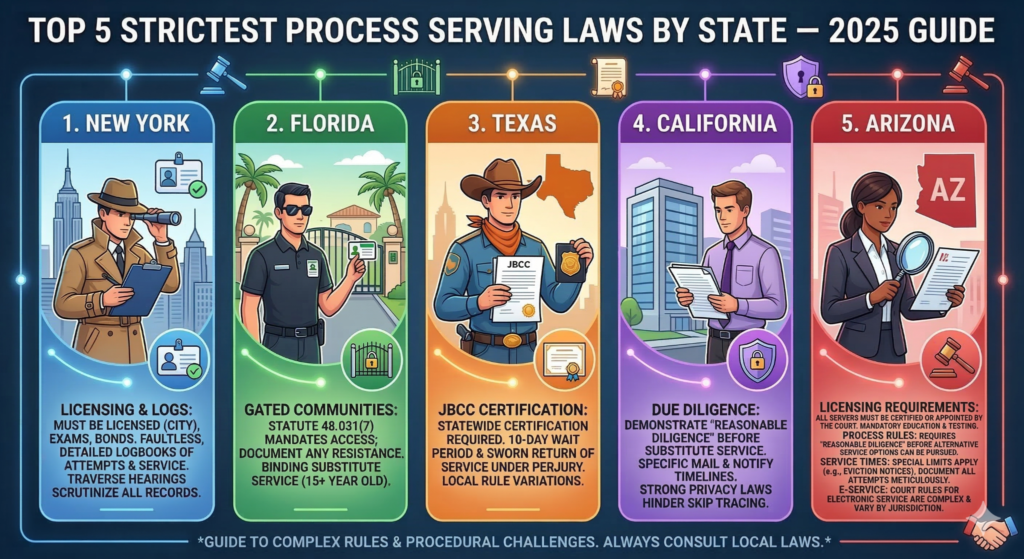
Service of process sits at the center of every civil lawsuit. Without proper delivery of legal documents, court proceedings cannot move forward. Yet many attorneys, paralegals, and self-represented litigants discover too late that the rules governing how, when, and by whom documents can be served differ significantly from state to state.
Some states leave the field mostly unregulated. Others have built layered systems of licensing, bonding, documentation, and timing requirements that demand careful attention. For anyone working with a process server or operating as one, understanding where the strictest rules apply can mean the difference between valid service and a dismissed case.
This guide covers the five states with the most demanding process serving requirements in 2025, along with practical guidance for staying compliant in each.
1. New York: The Most Regulated Process Server Market in the Country
New York City sets the standard for tight process serving oversight. Under New York City Administrative Code Title 20, individual process servers working in the five boroughs must obtain a license through the Department of Consumer and Worker Protection. Agencies face even higher requirements, including a $100,000 surety bond compared to $10,000 for individual servers.
Electronic record-keeping is mandatory. Process servers must log every attempt with GPS coordinates, timestamps, and detailed notes. Records must be retained for seven years. Background checks are part of the initial application, and servers operating without a license face steep fines and potential criminal liability.
For law firms serving documents in New York, working with a process server NY professional who holds current DCWP credentials and maintains compliant GPS tracking is not optional, it is a legal requirement.
2. California: Statewide Registration With County-Level Variations

Process serving in California is governed by the California Code of Civil Procedure, with additional oversight from the Secretary of State’s office. Any individual who serves more than ten documents per year for compensation must register as a process server with the county clerk where they primarily work.
Registration requires fingerprinting, a background check, and a $2,000 surety bond. Proof of service affidavits must be detailed and court-compliant to be accepted by California Superior Courts and Federal Courts operating within the state.
For a process server in Los Angeles, California, there are additional practical considerations. Gated residential communities, secured commercial buildings, and multi-tenant properties create access challenges that require documented service strategies. Substitute service rules under CCP 415.20 apply specific conditions before an alternate recipient can be used.
Ranworks’ California process serving services cover all 58 counties with GPS-tracked documentation on every attempt. Servers on the Ranworks team are registered with the Secretary of State, bonded, and insured, which matters when opposing counsel challenges the validity of service.
Process serving fees in California vary by location and urgency. Standard service in the San Diego metro starts at $75. Rush service in central Los Angeles runs $150. Expedited options are available for time-sensitive matters. Pricing reflects not just travel but the documentation burden that California law requires.
3. Florida: A Circuit-by-Circuit Certification Framework
Process serving in Florida operates through a judicial circuit certification model. The state has 20 judicial circuits, and certified process servers in Florida must be appointed within their specific circuit. Certification requires a background check, a bond, and an oath of office administered through the circuit court.
Service by a certified process server is valid throughout the state, but an appointment is circuit-specific. Servers cannot simply operate wherever they choose without proper certification in each circuit. Sundays are generally restricted for residential service unless a court grants specific authorization.
Florida’s framework means that multi-county litigation involving process serving in Florida can require coordination across multiple certified individuals or a single trusted firm with statewide coordination capacity.
4. Texas: Supreme Court Certification and Ongoing Education
Texas routes its process server oversight through the Texas Supreme Court, which maintains a formal certification program. Applicants must complete approved training, pass a written examination, and submit to a criminal background check.
Process serving in Texas also requires ongoing education to maintain certification. The state mandates a specified number of continuing education hours each renewal cycle, which helps keep servers current on rule changes under the Texas Rules of Civil Procedure.
Service documentation in Texas must be detailed enough to withstand a motion to quash. Courts look for specific information, including the date, time, location, and manner of service, along with a physical description of the individual served. Errors or gaps in this documentation can result in service being declared void.
5. Arizona: Supreme Court Oversight With Tribal Land Considerations
Arizona operates a Supreme Court certification model similar to Texas, with mandatory certification, background verification, and regular renewal requirements. What distinguishes Arizona from many other states is the additional complexity introduced by tribal land jurisdiction.
The state contains 22 federally recognized tribal nations. Service of process on tribal lands requires careful coordination with tribal authorities and an understanding of sovereign jurisdiction boundaries. Certified process servers in Arizona who operate in or near reservation areas must stay informed about tribal court rules, which can differ substantially from state civil procedure.
Continuing education requirements apply statewide, and servers must maintain active certification status or face suspension of their authorization to serve documents.
Understanding Process Server Cost Across These States
Process serving fees differ widely based on jurisdiction, urgency, and service difficulty. The table below reflects general market ranges for 2025.
| State | Standard Service | Rush Service |
| New York | $150 – $300 | $250 – $500 |
| California | $75 – $250 | $125 – $375 |
| Florida | $50 – $150 | $100 – $250 |
| Texas | $75 – $200 | $125 – $300 |
| Arizona | $45 – $150 | $95 – $250 |
Additional charges that commonly appear on invoices include skip tracing fees when the address on file is outdated, mileage for rural service locations, and notarization of affidavits where required by local court rules.
For California-based attorneys handling multi-state matters, Ranworks’ nationwide process serving coordination provides a single point of contact for all 50 states, which reduces the administrative work of managing multiple vendors across jurisdictions.
Professional Process Server Licensing Requirements in 2025
The requirements for becoming a licensed process server vary considerably by state, but a few baseline conditions appear across most regulated jurisdictions.
Applicants must typically be at least 18 years old, hold no disqualifying criminal record, complete any state-mandated training or examination, and obtain a surety bond before beginning work. States like New York and California go further by requiring fingerprinting and ongoing GPS documentation for every service attempt.
Legal document delivery laws by state continue to evolve. Several states that previously had no formal licensing requirements are now considering or actively implementing registration systems. Staying current with state-specific process serving rules is an ongoing responsibility for anyone in the field.
Ranworks’ skip tracing service is frequently bundled with process serving for cases where an address is outdated or a subject is avoiding contact, a common scenario in strictly regulated states where failed attempts still require formal documentation.
Frequently Asked Questions
1. What happens if a process server does not follow state-specific regulations?
Non-compliance can result in service being declared void, which may delay or dismiss the underlying case. In states like New York, servers can face license revocation, fines up to $10,000 per violation, and civil liability for damages caused by improper service.
2. Can substitute or alternative service methods be used when access is restricted?
Yes, but each state has its own threshold before alternative methods are permitted. California allows substitute service under CCP 415.20 after reasonable diligence is documented. Florida and Texas also permit alternative service, but typically require a court order first.
3. How do process serving fees get calculated in California?
Fees in California are based on the service location, travel distance, and urgency tier — standard, rush, or expedited. Urban counties like Los Angeles and San Diego typically have set base rates with add-ons for rural addresses, multiple attempts, or same-day service.
4. Are weekend and holiday service attempts permitted?
Rules vary by state. California generally restricts residential service to reasonable hours. Florida prohibits Sunday service without prior court authorization. Texas and New York require documentation of timing regardless of the day. Check state civil procedure rules before scheduling off-hours attempts.
5. Is GPS tracking required for process servers in all five of these states?
New York City requires GPS tracking by law. California does not mandate it by statute, but GPS documentation is widely used because it strengthens the proof of service and reduces the likelihood of a successful motion to quash. Florida, Texas, and Arizona do not require GPS, but many professional firms use it as standard practice.
Conclusion
The five states covered here represent the most regulated process serving environments in the country. Each has its own combination of licensing requirements, documentation standards, timing restrictions, and enforcement mechanisms. For attorneys managing cases that cross state lines, or for process servers looking to expand their operations, understanding these rules before service is attempted is far more practical than addressing defects after the fact.
State-specific process serving rules are updated regularly through court rule amendments, legislative action, and administrative guidance. Consulting the applicable state civil procedure rules or working with an experienced local firm in each jurisdiction remains the most dependable approach for ensuring valid service.
