Most people who encounter a process server have no idea what that person is legally permitted to do. The assumptions run in both directions; some believe process servers can go anywhere and do anything. In contrast, others think a locked gate or a “No Trespassing” sign ends their authority entirely. Neither is accurate.
Process server rights come from a specific combination of federal civil procedure rules, state statutes, and local court interpretations. Understanding where that authority begins and ends matters whether you are an attorney managing a case, a legal professional evaluating vendors, or someone who has just been served.
This guide covers seven areas where a legal process server holds authority that often surprises people, along with the genuine limits on each.
1. Property Access Rights, Including Gated Communities
A legal process server can enter private property to reach a front door. Walking up a driveway, crossing a yard, or passing a “No Trespassing” sign posted at the property boundary is generally permitted when the purpose is lawful service of process. Courts in California have consistently held that serving legal documents is a lawful purpose that overrides generic trespass restrictions on residential property.
What this does not include is forcing entry. A process server cannot climb a fence, open a locked gate without assistance, or enter through a window. Physical barriers remain barriers. The legal right is to approach, not to break through.

For gated communities and secured buildings, the standard approach is to work with building management or security staff. A process server in Los Angeles handling service to a high-rise residence, for example, will typically coordinate with the front desk. If access is denied after documented attempts, the server builds the record needed to request court authorization for substitute service.
Ranworks’ California process serving handles gated community and secured building situations regularly, with GPS-documented attempt records that courts accept without dispute.
2. Surveillance and Photography During Service Attempts
Process server surveillance rights allow servers to photograph and video-record their service attempts, the property exterior, the surrounding area, and any interaction that occurs during the attempt. This documentation supports the affidavit of service and protects the server if the recipient later claims they were never served.
What a server cannot do is record through windows into private interior spaces, use hidden recording equipment in states where two-party consent laws apply, or photograph individuals in locations where they have a reasonable expectation of privacy. The recording authority exists for the purpose of documenting service, not general surveillance of the recipient.
GPS documentation is a separate but related tool. Modern servers record coordinates and timestamps for every attempt, which creates a verifiable record tied to a specific location and time. In California, courts have accepted GPS-stamped affidavits as evidence of proper service when recipients contest whether service actually occurred.
3. Workplace Service of Process Rules
A process server can enter the public-facing areas of a business, like a reception area, a lobby, or a retail floor, and request to speak with the person named in the documents. If the recipient is present, service can be completed on the spot. If the recipient works in a secure area, the server may work with HR or management to arrange contact.
What can process servers legally do in a workplace?
They can identify themselves, state that they have legal documents to deliver, and request access to the named individual. They cannot access restricted areas without authorization, cannot represent themselves as anything other than a process server, and cannot create a disruption that interferes with business operations.
For corporate defendants, service typically goes through a registered agent. In California, the Secretary of State maintains a searchable database of registered agents for service of process, and serving the registered agent constitutes valid service on the corporation. This is the standard path for business litigation where the named defendant is a company rather than an individual.
4. Alternative and Substitute Service Methods
When direct personal service proves impossible after reasonable attempts, the process server authority extends to substitute methods, but only after specific conditions are met. California Code of Civil Procedure section 415.20 allows substitute service by leaving documents with a competent adult at the recipient’s home or workplace, followed by mailing a copy to the same address. The server must first make reasonable diligence attempts at personal service before substitute service is available.
Courts look at the number and timing of prior attempts when evaluating whether diligence was reasonable. A single attempt at one time of day generally does not satisfy the standard. Multiple attempts across different days and times of day build the documented record that justifies substitute service.
Electronic service has gained ground in certain jurisdictions, particularly for parties who have agreed to it in writing or when courts have specifically authorized it after traditional methods failed. This is not a default option; it requires either prior agreement or a court order.
5. Skip Tracing and Investigative Authority
When an address is outdated or a subject is actively avoiding contact, a legal process server can conduct investigative research to locate the current address. This includes searching public records, property ownership databases, vehicle registration files, court records, and business filings. The research must comply with the Fair Credit Reporting Act, the Gramm-Leach-Bliley Act, and applicable state privacy laws. Skip tracing for legal purposes, locating someone to complete service of process, is a permissible use under these frameworks.
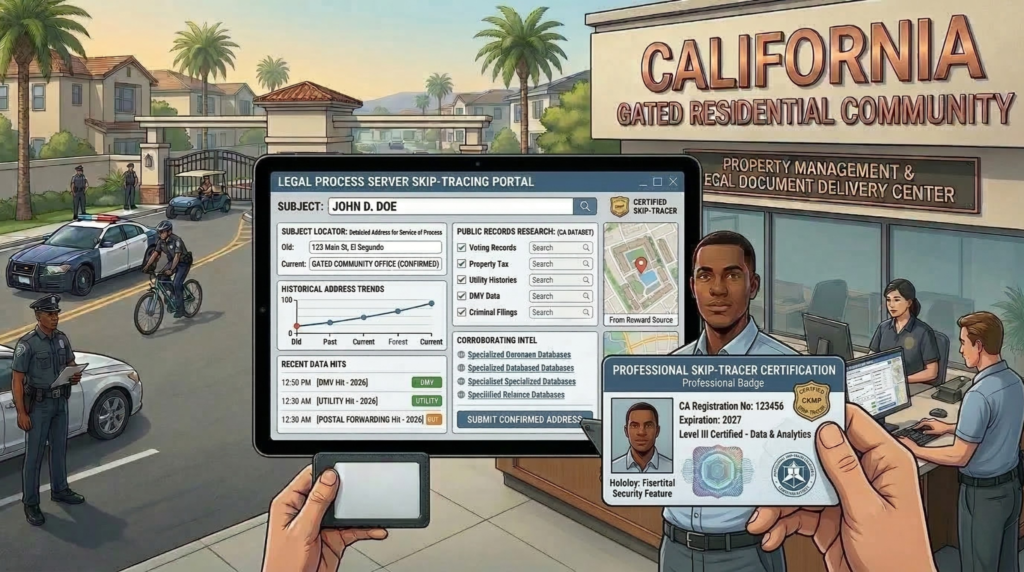
Monitoring public social media is also within bounds. If a recipient’s public Facebook or Instagram profile shows their location or schedule patterns, a server can use that information to plan service attempts. The keyword is public information that requires hacking, password access, or deception to obtain, and falls outside what process server rights cover.
Ranworks’ skip tracing services carry a 95% success rate for locating subjects with outdated or unknown addresses. Most searches are completed within 24 to 48 hours and are frequently bundled with process serving as a single assignment.
6. Service Timing Flexibility
California allows service of process at any hour of the day or night, though common practice follows a three-window framework: morning (6 AM to noon), afternoon (noon to 5 PM), and evening (5 PM to 10 PM) for residential addresses. The specific client instructions on a given assignment may narrow these windows further.
No California law restricts process serving to business hours for residential addresses. Courts have found service valid when completed at 7 AM or 8 PM, provided the manner of service was otherwise proper. Sunday service is permitted in California, unlike in some other states where weekend and holiday restrictions apply.
What this means practically is that a server handling a subject who is rarely home during the daytime can legally attempt service in the early morning or evening without violating any rule. The documented attempt record, showing multiple times across multiple days, is what ultimately supports a motion for substitute service if personal service cannot be completed.
7. Managing Evasive Recipients
When a recipient actively avoids being served, a process server can document the evasion pattern and present that documentation to the court. Evidence of deliberate avoidance, repeated absences at confirmed addresses, neighbors confirming the person lives there, vehicles present but no answer at the door, strengthens the case for alternative service authorization.
A server can also complete what California courts accept as “acknowledgment service” in some circumstances, where the recipient sees the server, the server identifies themselves and states they are attempting service, and the recipient walks away or closes the door. If the server can then place documents near the recipient and document that the person was aware of the attempt, courts in some jurisdictions treat this as valid service.
Ranworks’ nationwide process serving team handles evasive recipients across California and all 50 states, with documentation standards built specifically to support motions for alternative service when standard attempts are defeated.
Conclusion
Process server authority is grounded in law, not in the server’s personal discretion. The seven areas covered here are property access, surveillance documentation, workplace service, substitute methods, skip tracing, timing flexibility, and evasion response. Each has a clear legal basis and equally clear limits. Knowing both sides of that line is what separates valid service from a motion to quash.
For law firms and attorneys handling cases where service is complicated by access challenges, uncooperative recipients, or outdated addresses, working with a registered and bonded California process server with documented GPS tracking and a clear methodology reduces risk at every stage.
Frequently Asked Questions
1. What can process servers legally do when a recipient refuses to take the documents?
Refusing to physically accept documents does not prevent valid service in California. If a process server identifies the correct person and the person refuses to take the papers, the server can place the documents near the recipient and note the refusal in the affidavit. California courts have consistently treated this as completed service.
2. Do process server surveillance rights allow recording inside a home?
No. Recording authority covers exterior approaches, public-facing interactions, and documentation of the service attempt itself. Recording through windows or into private interior spaces falls outside what process server rights permit and may violate state wiretapping or privacy statutes.
3. What are the gated community process server access rules in California?
A process server has the right to request access through a gated entry for the purpose of completing lawful service. If access is denied by security or management, the server documents the attempt and builds the record for substitute service or a court order authorizing alternative methods. Forcing entry through a gate is never permitted.
4. How does workplace service of process work for corporate defendants?
For corporations and LLCs, service typically goes to the registered agent for service of process on file with the California Secretary of State. The registered agent accepts documents on behalf of the company and assumes responsibility for forwarding them internally. Direct service to a corporate officer is also valid if the registered agent cannot be reached.
5. When can a process server use skip tracing to find someone?
Skip tracing is authorized when the address on file is outdated, mail has been returned as undeliverable, or prior service attempts have failed to locate the subject at the known address. The research must be conducted for a lawful legal purpose and must comply with FCRA and applicable state privacy laws.