Delivering legal documents to California correctional facilities requires more than dropping an envelope in the mail. The California Department of Corrections and Rehabilitation (CDCR) operates under a specific set of rules governing how legal mail is addressed, processed, and delivered to incarcerated individuals. Attorneys who overlook these rules risk rejected mail, missed court deadlines, and gaps in the attorney-client privilege record that can affect an entire case.
This guide covers CDCR legal mail regulations, proper addressing requirements, delivery timelines, and special handling for transcripts. It explains when working with a professional process server makes more sense than managing delivery in-house.
Understanding California CDCR Legal Mail Rules
Legal mail in the California prison system receives a distinct classification under Penal Code section 2601, subdivision (b). Any correspondence sent between attorneys and incarcerated clients falls under confidentiality protections, meaning mailroom staff cannot open or read it without the incarcerated person’s permission. This protection keeps attorney-client privilege intact from the moment a document leaves your office to the moment it arrives at a correctional facility.
The CDCR recognizes several document types as legal mail. These include court correspondence, attorney communications, legal reference materials, case transcripts, habeas corpus petitions, appeal documents, and compliance notices addressed to prison administrators.
Addressing Requirements
Correct addressing is the single most common reason prison legal mail gets rejected or delayed. Every piece of legal mail sent to a California correctional facility must include the incarcerated person’s full legal name, their CDCR number, current housing unit or facility designation, the complete institution mailing address, and a return address that matches the sender’s address on file with the California State Bar.
The CDCR is required to update the housing address on any mail that reflects an outdated location, but relying on that correction adds processing time. Obtaining the current housing assignment before sending documents is worth the extra step.
Delivery Timelines
Standard legal mail must reach the incarcerated person within seven calendar days of arriving at the institution’s mailroom, per CDCR regulations. Larger packages containing legal materials must be delivered within 15 calendar days, though holiday periods and facility lockdowns can extend that window. Legal mail moves through this system faster than general correspondence because of its confidential classification, but attorneys should still build buffer time into any schedule where court deadlines are involved.
Professional Legal Document Delivery Options
Attorneys handling high volumes of correctional mail or managing complex, time-sensitive filings often work with professional legal support services rather than using standard postal routes. A professional process server familiar with California correctional facilities understands CDCR addressing requirements, knows how to handle rejection disputes, and provides documented proof of delivery that holds up in court.
Ranworks offers process serving throughout California with GPS-tracked documentation on every attempt. That documentation includes exact location coordinates, timestamps, a physical description of the person served, and the server’s declaration under penalty of perjury. For attorneys who need a clean, verifiable paper trail on correctional deliveries, that level of documentation matters.
Cost Considerations
Professional delivery services for California correctional facilities typically run between $40 and $200 per delivery, depending on distance to the facility, urgency, document volume, and any special handling requirements. Rush and same-day options carry a premium, but for cases where a missed delivery carries significant legal consequences, the cost is straightforward to justify.
Standard process serving from Ranworks in the San Diego metro area starts at $75. Rush service adds $50, and expedited same-day service adds $125. Pricing varies by county, with a full breakdown available on the Ranworks pricing page.
Special Handling for Transcripts and Large Documents
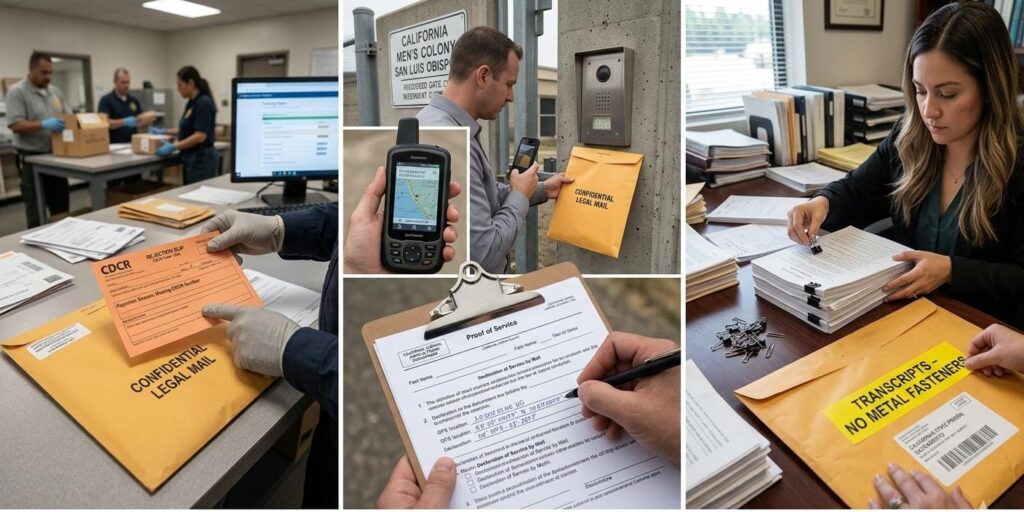
Court transcripts and large case files require a different delivery approach than standard legal correspondence. The CDCR instructs that transcripts be sent to incarcerated clients through a trackable carrier service such as UPS, which provides both a tracking number and insurance as part of standard shipment coverage.
A few rules apply specifically to transcript delivery. Carriers like UPS cannot deliver to a Postal Box address, so the street address for the facility must be used. The package must be clearly marked “Confidential Legal Mail” along with the attorney’s name and return address. That return address must match the address on file with the California State Bar. Metal fasteners of any kind, including staples and binder clips, must be removed before packaging. If a stapled document makes it through and gets flagged in the mailroom, staff will remove the fastener in the presence of the incarcerated individual, which adds delay and handling to an already time-sensitive situation.
If a facility refuses a carrier delivery based on their interpretation of regulations, the recommended course of action is to contact the prison’s litigation coordinator directly and request assistance. Most facilities have a designated point of contact for exactly this kind of dispute.
Mail Inspection and Confidentiality Protocols
General incoming mail at California correctional facilities can be scanned or read in full by mailroom staff. Legal mail is handled differently. Under CDCR policy, legal mail is processed according to confidentiality procedures that preserve the attorney-client relationship. The practical requirement is that legal mail must be clearly identified as such, and the sender must be a licensed attorney whose State Bar address matches the return address on the envelope.
Certain items are prohibited regardless of document type. Metal fasteners top that list. Documents containing prohibited photographs, non-legal correspondence bundled with attorney mail, or items that otherwise violate CDCR regulations will be returned or confiscated. Understanding these restrictions before sending avoids delays that can compound quickly when court deadlines are approaching.
Electronic Filing and Its Limits in Prison Cases
California courts have expanded electronic filing significantly across all 58 Superior Courts and all four U.S. District Court districts in the state. For most attorneys, e-filing is now the standard approach for submitting documents to the court. The limitation in correctional cases is that the incarcerated individual still needs a physical copy of whatever is filed.
Ranworks handles court filing services for all California courts at $22.95 plus applicable court fees. For attorneys who want to file electronically and then arrange physical delivery of filed-stamped copies to an incarcerated client, bundling those two steps with a single vendor saves coordination time. E-filed documents typically receive confirmation within two to four hours during court business hours. Physical delivery to the correctional facility is a separate step that follows once the filed-stamped copy is available.
Best Practices for Attorneys and Legal Professionals
Documentation and Tracking
Every delivery attempt to a correctional facility should be documented. Keep delivery confirmation receipts, tracking numbers with delivery dates, records of any communication with facility staff, and copies of the properly addressed label or envelope. If service is later questioned, that paper trail is what resolves the dispute.
Professional services provide this documentation automatically. GPS-tracked delivery records with timestamps, server declarations, and address confirmation give attorneys court-ready proof without building a separate tracking system internally.
Timing and Deadline Planning
Plan correctional deliveries further ahead than standard court filings. Standard legal mail must arrive within seven calendar days of reaching the mailroom, but that clock starts at the mailroom, not at your office. Add transit time, potential facility processing delays, holiday schedules, and any possible rejection and resubmission cycle when calculating backward from a court deadline.
For cases where an incarcerated client cannot be located at a previously known correctional facility, skip tracing services can locate current housing assignments using CDCR databases and public records. Ranworks completes most skip traces within one to two weeks, with a 95 percent success rate on cases where at least one identifying piece of information is available.
Choosing a Delivery Service
When evaluating delivery options for California prison legal document work, the factors that matter most are experience with correctional facilities, the ability to provide court-accepted proof of delivery, responsiveness when a delivery is rejected, and whether the service provider can handle both the delivery and any related court filing in one workflow.
Ranworks has served California law firms since 2002 and is based in San Diego with coverage throughout Los Angeles County and Orange County. Their servers are licensed and bonded, registered with the California Secretary of State, and carry full insurance. For out-of-state correctional matters, they coordinate with a nationwide network of licensed servers.
Legal Aid Resources for Incarcerated Individuals
Several nonprofit organizations assist with prison legal matters in California. The Prison Law Office is a public interest law firm focused on reducing incarceration and advocating for fair treatment under the Constitution for people in prisons, jails, and juvenile facilities. They handle systemic litigation and provide legal support for individuals who cannot afford private counsel.
Legal Services for Prisoners with Children is a 501(c)(3) nonprofit and a California State Bar-designated legal support center. Every CDCR facility also maintains a law library for the incarcerated population, providing access to legal research materials and court forms. The governing mail regulations are codified in the California Code of Regulations, Title 15, which attorneys can reference directly when preparing correctional deliveries.
Conclusion
California prison legal document delivery is a process with specific rules that carry real consequences when they are not followed. CDCR addressing requirements, delivery timelines, transcript handling rules, and mail inspection protocols each represent a point where a delivery can succeed or fail.
Attorneys working regular correctional caseloads typically find that the documentation standards and turnaround consistency of a professional service outweigh the cost. For firms managing deadline-sensitive filings, the combination of process serving and court filing through a single vendor reduces coordination overhead and provides a single audit trail from document preparation through court acceptance.
Ranworks has served California law firms in this capacity since 2002. For attorneys managing California prison legal document delivery alongside broader case needs, their licensed servers, GPS-tracked documentation, and statewide coverage offer a practical solution.
Frequently Asked Questions
1. How much does California prison legal document delivery typically cost?
Professional delivery services generally run between $40 and $200 per delivery. The final price depends on distance to the facility, urgency, document volume, and special handling needs. Rush and same-day options carry additional fees. Ranworks publishes county-level pricing for California process serving on its website.
2. Can an attorney send legal documents directly to a California prison without using a service?
Yes. Attorneys can send legal mail directly through USPS or a trackable carrier. Documents must be clearly marked “Confidential Legal Mail,” addressed with the incarcerated person’s CDCR number, and carry a return address matching the sender’s State Bar record. Professional delivery services offer the advantage of documented proof of delivery that meets court standards.
3. What happens when a California prison rejects a legal mail delivery?
The facility is required to notify the sender of the rejection reason using CDCR Form 1819. If the rejection appears unwarranted, the attorney or delivery service should contact the prison’s litigation coordinator directly. Professional services typically handle rejection disputes and redeliver at no additional charge.
4. How long does legal mail take to reach someone inside a California prison?
Under CDCR regulations, legal mail must be delivered to the incarcerated person within seven calendar days of arriving at the institution’s mailroom. Larger packages, including transcript deliveries, are allowed up to 15 days. Facility lockdowns and holiday periods can extend both of those timelines.
5. Are there specific rules for delivering court transcripts to California prisons?
Yes. Transcripts must be sent through a trackable carrier service that provides a tracking number and insurance. Carriers like UPS require a street address rather than a P.O. box. Packages must be marked “Confidential Legal Mail” with the attorney’s name and State Bar return address. Metal fasteners of any kind must be removed from all documents before packaging.