
Most attorneys treat the proof of service as a formality. Courts do not. California judges will not hear a motion, enter a default, or act on any filed document unless a valid proof of service is on file. A defective one does not just delay the matter under California Code of Civil Procedure section 473; it gives the opposing party grounds to set aside any order or judgment obtained based on improper service, at any point.
The California Judicial Branch processed more than 4.8 million cases in fiscal year 2023–24, according to the 2025 Court Statistics Report. In every one of them, a properly completed proof of service was the threshold requirement before any judicial action could be taken.
This guide covers which form to use, what the document must contain, the most common defects, and what is changing under AB 747 in 2027.
Which Form to Use
California uses different proof of service forms depending on what was served and how. Using the wrong one is the most common defect that triggers rejection at the filing window. All Judicial Council forms are available through the California Courts self-help portal.
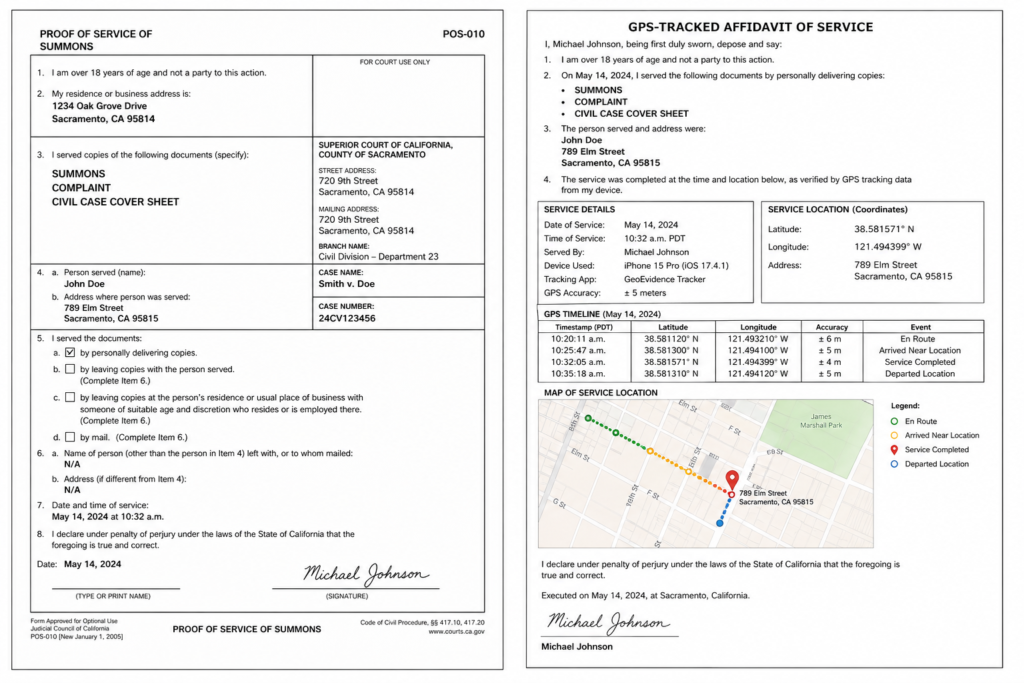
POS-010 — Proof of Service of Summons. Use this when serving the initial summons and complaint to open a lawsuit. This is the most legally consequential form of proof of service family because it establishes the court’s jurisdiction over the defendant. It covers personal service, substitute service, and service on corporations or government entities.
POS-020 — Proof of Personal Service (Civil). Use this for subsequent civil documents served in person after the case is open — motions, orders to show cause, restraining orders. It does not apply to the summons and complaint.
POS-040 — Proof of Service (Civil). Use this for subsequent documents served by mail or electronic service on represented or self-represented parties.
POS-050 / EFS-050 — Proof of Electronic Service. Use this when both parties have agreed to electronic service under California Rules of Court rule 2.251.
Family law matters use separate forms: FL-115 for the proof of service of summons, FL-330 for personal service, and FL-335 for service by mail.
What It Must Contain
Under CCP sections 417.10 and 417.20, every California proof of service must establish seven things regardless of which form is used.
Who served. The server’s full name, address, and registration number if they are a registered process server, plus a statement that they are over 18 and not a party to the case.
Who was served? The full name of the person or entity. For substitute service, a physical description of the person who accepted the documents.
What was served? A complete list of every document delivered. If the list does not fit on the form, attach POS-040(D).
Where. The exact address of delivery. For service in an unusual location, a description of the place.
When. For personal service, the date and time of delivery. For substitute service, two separate dates are required: the date documents were left with the substitute, and the date the follow-up mailing was sent. Both are mandatory.
How. Which service method was used? Only one method per form. Checking the wrong box or mixing methods on a single form are defects that surface repeatedly in challenged cases.
Server’s signature under penalty of perjury. An unsigned proof of service is void without exception.
When substitute service is used, a separate Declaration of Due Diligence must accompany the proof of service. This declaration lists every prior personal service attempt with date, time, location, and what occurred. Under Espindola v. Nunez (1988) 199 Cal.App.3d 1389, two to three varied attempts satisfy reasonable diligence. A thin declaration with one attempt, or two visits at the same time on consecutive days, is the most common reason substitute service gets quashed.
How Courts Evaluate the Document
A proof of service signed by a registered process server carries an evidentiary presumption of validity. The burden shifts to the opposing party to disprove service rather than on the plaintiff to prove it. That presumption disappears when the form has defects.
Common defects that courts have found to defeat validity include an incorrect address, a description inconsistent with the person actually served, a missing mailing date for substitute service, or a signature identifying the wrong server. Any of these can be used to challenge service under CCP 473.
For attorneys managing active caseloads, California process serving handled by a registered, GPS-tracked team removes this evidentiary risk. Ranworks’ affidavits include coordinates, timestamps, and server registration details for every attempt — documentation courts accept without challenge.
What Changes Under the SPARE Act in 2027
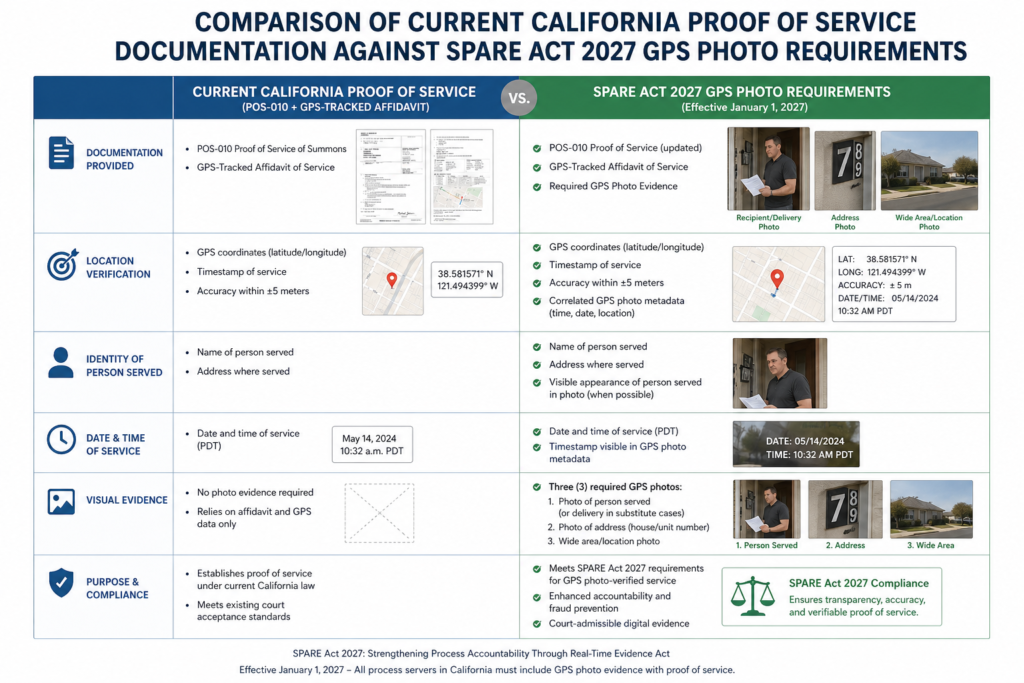
AB 747, the Service of Process Accountability, Reform, and Equity Act, was signed in October 2025 and takes effect January 1, 2027. It is the most significant reform to California’s service of process rules in over 50 years. The full text of AB 747 is available on the California Legislature website.
The Act introduces three direct changes to proof of service requirements.
Mandatory GPS photographs. For unlawful detainer cases served personally, by substitute service, or by posting, the proof of service must include at least one date-, time-, and GPS location-stamped photograph of the service location. If no signal is available, a detailed written statement is required instead.
Codified diligence standard. “Reasonable diligence” is now defined in statute as at least three good-faith personal service attempts on three different days at three different times before substitute service may be used.
Public server registry. County clerks must maintain a publicly accessible register of all registered process servers.
Crucially, once the SPARE Act is in force, any default judgment obtained without compliant proof of service documentation can be challenged at any time with no statute of limitations on the challenge. Attorneys with cases that will be active past January 1, 2027, should review their process server documentation practices now.
For proof of service filing and court submissions, Ranworks court filing services handle e-filing throughout California, so the affidavit reaches the court the same day service is confirmed.
Common Defects That Invalidate Service
A few mistakes appear with enough frequency to be worth naming directly.
Wrong form. POS-010 for motions, or POS-040 for the initial summons — using the form meant for a different document type is a filing defect that courts reject, and opposing parties exploit.
Missing mailing date for substitute service. The physical delivery and the follow-up mailing are two separate events. The proof must record both dates. Leaving the mailing date blank is one of the most common defects in substitute service affidavits.
Insufficient description of the substitute recipient. Noting only “adult female” without age, height, or other identifying details gives a defendant an easy basis to argue the documents were left with the wrong person.
Self-service. A party to the case cannot serve its own documents. If the proof is signed by someone who is named in the action, the service is void regardless of how carefully it was documented. Using Ranworks’ skip tracing services to confirm a current address before assigning service avoids the cost and delay of failed attempts entirely.
A full summary of California’s service of process statutory framework is available through the Cornell Law Legal Information Institute for those wanting to review the underlying statutes before filing.
Frequently Asked Questions
Q1. What is a proof of service in California, and why is it required?
A proof of service is a signed declaration completed under penalty of perjury confirming that legal documents were properly delivered to the named party. California courts will not take any judicial action, including hearing motions or entering defaults, without a filed proof of service on record. Without it, the case cannot legally move forward.
Q2. Which proof of service form do I use in California?
Use POS-010 for the initial summons and complaint. Use POS-020 for subsequent documents served in person. Use POS-040 for subsequent documents served by mail. Use POS-050 for electronic service. Family law cases use FL-115, FL-330, or FL-335 depending on what was served and how. Using the wrong form is a defect that courts will reject, and opposing parties will use.
Q3. What must a California proof of service include?
Under CCP 417.10 and 417.20, the proof must state who served the documents, who was served and where, the complete list of documents, the date and time of service, the service method, and the server’s signature under penalty of perjury. For substitute service, a Declaration of Due Diligence detailing all prior personal service attempts must be attached separately.
Q4. Can a proof of service be challenged after a default judgment is entered?
Yes. Under CCP 473, a party can move to set aside a void judgment at any time based on improper service. AB 747, effective January 1, 2027, further confirms that default judgments obtained through unlawful service can be challenged without any time limitation, adopting the California Supreme Court’s 2024 ruling in California Capital Insurance Co. v. Hoehn.
Q5. How does the SPARE Act change proof of service requirements in California?
AB 747 takes effect January 1, 2027. For unlawful detainer cases, proofs of service must include at least one GPS location-stamped photograph of the service site. “Reasonable diligence” is codified as a minimum of three good-faith attempts on three different days at three different times. County clerk process server registers must also be made publicly available. Attorneys with active cases past January 1, 2027, should review their documentation practices and process server relationships now.
Conclusion
A proof of service is the document that gives California courts the authority to act. Getting it right using the correct form, capturing every required field, attaching the due diligence declaration when needed, and filing it the same day service is confirmed, is what separates service that holds from service that gets set aside months later.
Attorneys and individuals who need GPS-tracked, court-compliant proof of service documentation can contact Ranworks Legal Support Services at 888-636-0293 or email documents@ranworks.com.
