
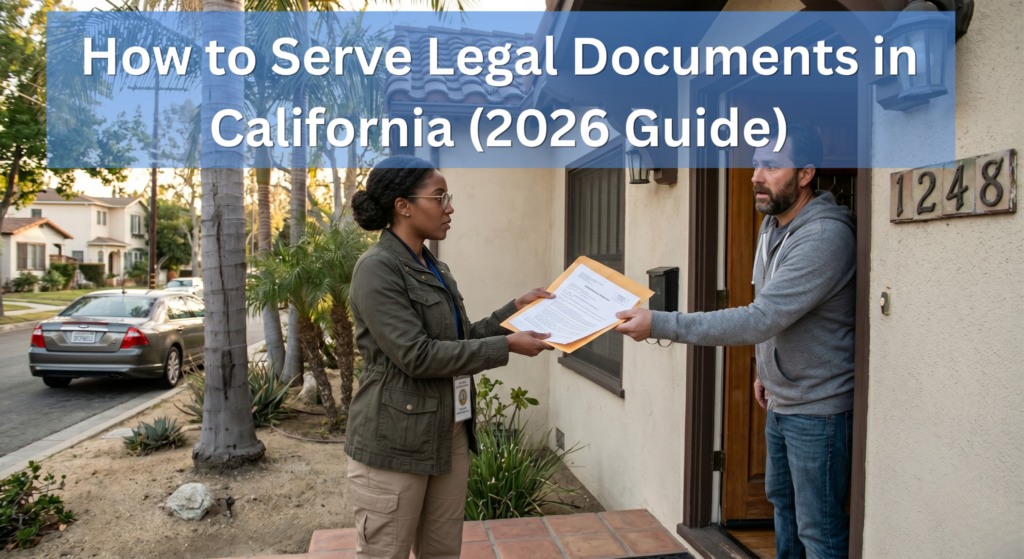
A process server doesn’t just deliver papers; they deliver turning points in people’s lives, carrying with them the weight of moments that can change the course of someone’s personal or professional journey.
California’s courts handled more than 4.8 million cases in fiscal year 2023–24, according to the 2025 Court Statistics Report published by the Judicial Branch of California. Service of process was a required step in every one of them. Get it right and your case proceeds. Get it wrong, and the court may quash the service, allow the defendant to vacate a default judgment, or, in serious cases, dismiss the action entirely. None of those outcomes is recoverable without significant time and cost.
This guide covers the four approved service methods under the California Code of Civil Procedure, who is permitted to serve, what your proof of service must contain, and the mistakes that most commonly derail cases.
Who Can Serve Legal Documents in California
The most common mistake is thinking you can serve the documents yourself. Under California Code of Civil Procedure section 414.10, any person who is at least 18 years old and is not a party to the case may serve process. You cannot serve your own legal documents under any circumstance.
Parties typically use one of four options: a friend or family member over 18 who is not named in the case, the county sheriff or marshal, a registered California process server, or the attorney’s own staff.
California Business and Professions Code section 22350 requires anyone serving more than 10 documents per year for compensation to register with the county clerk in their county of residence. Under sections 22350 through 22360, registration also requires fingerprinting and posting a $2,000 surety bond. That registration requirement has increased the number of credentialed servers statewide as litigation volume has grown. Crucially, affidavits from registered servers carry an evidentiary presumption of validity in court; the burden shifts to the opposing party to disprove service, rather than on you to prove it.
For attorneys and law firms managing active caseloads, California process serving handled by a registered, GPS-tracked team removes the administrative risk of a defective service challenge entirely.
The Four Approved Methods of Service
California Code of Civil Procedure sections 415.10 through 415.50 establish four methods for serving an individual. The correct method depends on whether the person can be located, how many attempts have been made, and what the court has authorized.
Personal Service (CCP 415.10)
Personal service is the default and the method California courts prefer. It means physically handing the documents to the person being served, at home, at work, or wherever they can be found.
Service is complete the moment the documents are delivered. The server does not need the recipient’s cooperation. If the defendant identifies themselves and then refuses to take the papers, the server can leave them nearby, and service remains valid. Courts have consistently held that a defendant cannot defeat service by turning away or throwing the papers on the ground. The California Supreme Court instructed in Pasadena Medi-Center Associates v. Superior Court (1973) 9Cal. .3d 773, 778 that service statutes should be construed liberally “to effectuate service and uphold the jurisdiction of the court if actual notice has been received by the defendant.” Avoidance after identification does not undo service.
For corporations and LLCs, service goes to the registered agent for service of process listed with the California Secretary of State, or to a corporate officer or general manager if the agent cannot be reached. For government agencies, serve the city clerk, county clerk, or the California Attorney General’s office, depending on which entity is sued.
Substitute Service (CCP 415.20)
When personal service cannot be completed after reasonable diligence, substitute service becomes available. The legal standard comes from Espindola v. Nunez (1988) 199 Cal.App.3d 1389, where the Court of Appeal held that “ordinarily, two or three attempts at personal service at a proper place should fully satisfy the requirement of reasonable diligence and allow substituted service to be made.” That holding was reaffirmed in Bein v. Brechtel-Jochim Group, Inc. (1992) 6 Cal. App. 4th 1387 and remains the benchmark that California courts apply.
As one California attorney summarized in a widely cited Avvo response on exactly this question, “The standard number used is three attempts… before the process server hands the documents to an adult at the residence or a person in charge at the place of business, then serves a copy by US Mail.” What courts look for is not just the count but the spread. A log showing three visits at 9 AM on consecutive weekdays does not demonstrate varied timing. A log showing an 8 AM Tuesday attempt, a 6 PM Thursday attempt, and a Saturday midday attempt is far more defensible.
Substitute service allows the server to leave documents with a competent household member at least 18 years old at the person’s residence, or with the person apparently in charge at their place of business. A copy must then be mailed to the same address by first-class mail. Service is not complete on the day of delivery under CCP 415.20; service is deemed complete 10 days after the mailing. This affects your calculation of response deadlines.
For business defendants, substitute service is available on the first visit if the owner or person in charge is not present.
Service by Mail with Acknowledgment (CCP 415.30)
California permits service by first-class mail when the recipient agrees in writing to accept it. The sender mails the documents with two copies of a Notice and Acknowledgment of Receipt form. The recipient signs and returns one copy within 20 days, and service is complete on the date that acknowledgment is mailed back. This method depends entirely on the recipient’s cooperation — if they do not return the form within 20 days, service is not complete, and you must use another method.
Service by Publication (CCP 415.50)
Service by publication is the option of last resort and requires a court order. Before granting it, the court needs a declaration detailing every step taken to locate the defendant, addresses searched, databases checked, and relatives or associates contacted. If approved, the summons is published once weekly for four consecutive weeks in a newspaper of general circulation in the county where the defendant last resided. Service is complete on the 28th day after the first publication.
Before reaching this stage, most attorneys first try skip tracing services to locate the defendant’s current address, employer, or other contact points. A professional skip trace frequently finds someone who has moved or is avoiding service, eliminating the need for publication.
What the Proof of Service Must Contain
Service is only as good as the documentation that follows it. The server must prepare a proof of service, also called a declaration or affidavit of service, covering every material fact about the delivery.
California courts use Judicial Council Form POS-010 for the initial summons and complaint, and POS-040 for subsequent documents. The form must include the name and address of the person served, the date and time of service, the method used, a description of the person served when relevant, and the server’s signature under penalty of perjury.
For substitute service, the proof must also include a declaration of due diligence detailing the prior personal service attempts that made substitute service necessary, with dates, times, locations, and what occurred at each attempt.
GPS-tracked service affidavits include exact coordinates and timestamps for every attempt, which courts accept without challenge. A registered process server’s affidavit carries a legal presumption of valid service that a layperson’s declaration does not. Once complete, the proof of service must be filed with the court. Many attorneys bundle this with court filing services, so the affidavit is e-filed the same day service is confirmed.
Common Mistakes That Invalidate Service
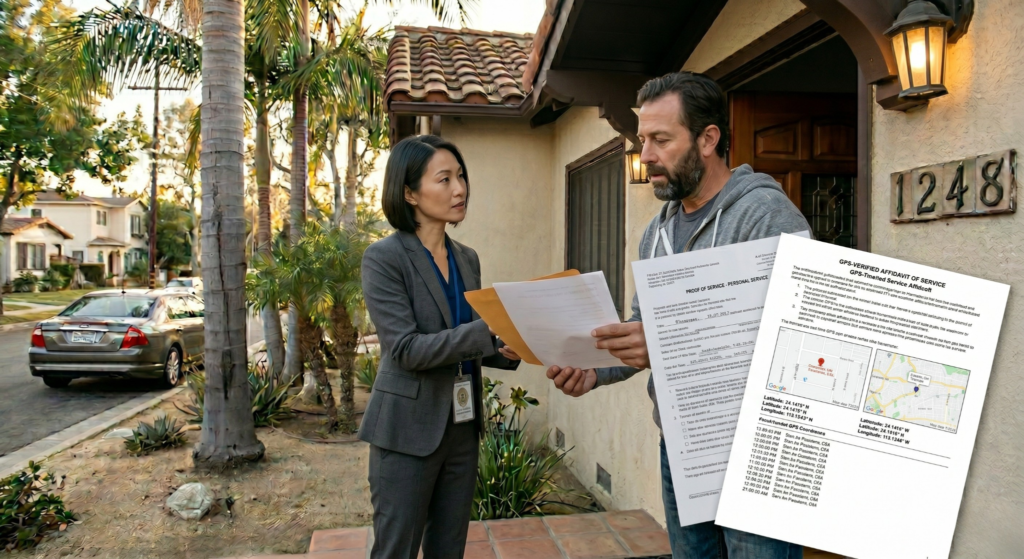
A few patterns come up repeatedly when service is challenged in California courts.
Serving the wrong person. In substitute service situations, leaving documents with someone who does not actually live at the address, or who is under 18, renders service invalid.
Missing the mailing step. The physical delivery is only the first half of the substitute service. The follow-up mailing is required, and without it, the service is defective regardless of the delivery.
Thin due diligence before substitute service. Under Espindola, two to three well-varied attempts are the accepted standard. A single attempt before switching to substitute service will not hold up if the defendant challenges.
Serving your own documents. An absolute bar under California law. No matter how informal the matter, the server must be a non-party who is at least 18 years old.
One forward-looking note: AB 747, known as the SPARE Act, was signed in October 2025 and takes effect January 1, 2027. It overhauls California’s service of process rules with tighter accountability requirements and new proof of service standards targeting undocumented service practices. After that date, the evidentiary demands on documentation will increase, making the case for registered, GPS-tracked service even stronger.
Frequently Asked Questions
Q1. Can I serve legal documents myself in California?
No. California Code of Civil Procedure section 414.10 requires service to be performed by someone at least 18 years old who is not a party to the case. Even if the other party would willingly accept the documents from you, self-service is invalid. A third party must complete the service on your behalf.
Q2. How many attempts are required before substitute service is allowed in California?
California law requires “reasonable diligence” under CCP 415.20 without specifying a fixed number. The controlling case is Espindola v. Nunez (1988) 199 Cal.App.3d 1389, which held that “ordinarily, two or three attempts at personal service at a proper place should fully satisfy the requirement of reasonable diligence.” What courts focus on is the spread — attempts at different times of day and different days of the week. A detailed log of each attempt, including date, time, location, and result, is what protects the service from a challenge.
Q3. When is service by publication available in California?
Service by publication under CCP 415.50 is available only after a court grants a specific order. The plaintiff must file a declaration showing the defendant cannot be located despite a genuine investigative effort. Once authorized, the summons is published once weekly for four consecutive weeks, and service is complete on the 28th day after the first publication.
Q4. What makes a proof of service defective in California?
Common defects include the wrong service method checked on the form, a missing description of the person who accepted substitute service, no mailing confirmation for substitute service, an unsigned or undated declaration, service by a party to the case, and an incorrect address. Any of these can give a defendant grounds to challenge service under CCP 473 and, if successful, vacate a default judgment.
Q5. How long do I have to serve the defendant after filing a lawsuit in California?
Under CCP 583.210, the summons and complaint must be served within 60 days of filing. Courts routinely grant extensions when the plaintiff can show a good faith effort, but repeated failures to serve within the statutory period can result in dismissal. If the deadline is approaching and service has not been completed, engage a registered process server immediately or consider skip tracing if the defendant’s location is unknown.
Conclusion
Service of process in California follows clear procedural rules, but the details of which method applies, how many attempts are enough, what the proof of service must say, and whether service holds up when challenged. Personal service is the standard. Substitute service requires documented prior attempts. Service by mail depends on cooperation. Publication is the last option when the court has granted permission.
Attorneys and individuals who need documents served correctly and on time can contact Ranworks Legal Support Services at 888-636-0293 or email documents@ranworks.com. Standard service completes within three to five business days. Rush and same-day options are available when deadlines cannot be met.
