Court Filing

Same Day Court Filing in San Diego: What It Is, How It Works, and When to Use It

A statute of limitations closing by end of day. A hearing set for tomorrow morning. A restraining order that has to reach the clerk’s window before 4:30 PM. These are the moments when same day court filing in San Diego stops being a convenience and becomes a necessity. This guide explains exactly what same day court filing in San Diego is, how the process works step by step, which situations call for it, and what to look for in a rush court filing service in San Diego attorneys can rely on when the deadline is real and the margin for error is zero. Ranworks Legal Support Services has provided court filing services San Diego attorneys and law firms depend on since 2002, handling same day e-filing and same day physical delivery to all divisions of San Diego Superior Court and its branch locations. What Is Same Day Court Filing in San Diego? Same day court filing in San Diego means submitting legal documents to the court and receiving confirmation of acceptance within the same business day the request is made. This applies to both electronic filing and physical delivery to the courthouse clerk. It is not simply a faster version of standard court document filing. Same day filing requires immediate prioritization of the assignment, direct coordination with the court’s filing windows or e-filing portal, and confirmation returned to the client before the court closes for the day. Same day court filing in San Diego is the process of submitting legal documents to San Diego Superior Court and receiving confirmation of filing acceptance on the same business day. It is available via e-filing, which completes within 2 to 4 hours, or physical delivery to the courthouse when submitted before the daily cutoff time of 2 PM for San Diego County. It is used when statutes of limitations, hearing deadlines, or restraining orders require documents to be on the court’s record by end of business that day. How Does Same Day Court Filing Work in San Diego? Same day court filing in San Diego works through two distinct channels depending on what the court requires for your specific document type: Same Day E-Filing Electronic filing through an approved court portal is the fastest method. Documents are submitted digitally, processed by the court, and a transaction confirmation with the official filing timestamp is returned typically within 2 to 4 hours during court business hours. The submission timestamp is the legally significant time for deadline purposes, not the court’s processing time. Same Day Physical Delivery When e-filing is not available for a specific document type, when originals are required, or when the document requires clerk review before acceptance, physical delivery to the courthouse is the alternative. A courier or process server hand delivers the documents to the clerk’s window, waits for file stamping, and returns filed-stamped copies to the client. For San Diego County, same day physical delivery requires the assignment to be submitted to Ranworks before 2 PM. Documents received after this cutoff may not be processed until the following business day. Step by Step: How to Request Same Day Court Filing in San Diego Confirm your deadline and identify whether e-filing or physical delivery is needed for your document type and court division. Prepare your documents in the correct format. For e-filing, documents must be text-searchable PDF files. For physical delivery, originals or certified copies as required by the court should be ready. Email your documents to documents@ranworks.com with the case number, court division, document type, and the specific deadline you are working against. Ranworks confirms receipt and assigns the filing as a rush priority immediately upon intake. For e-filings, Ranworks submits through the approved e-filing portal, pays filing fees on your behalf, and monitors the submission through court acceptance. For physical delivery, a courier is dispatched to the appropriate San Diego Superior Court location before the clerk’s filing window closes. You receive the court-issued eFiling receipt and transaction confirmation for e-filings, or the filed-stamped copy with photo documentation for physical delivery, as soon as the court accepts the submission. When Do You Need Same Day Court Filing in San Diego? Most routine litigation does not require same day filing. The situations that do require it share one thing in common: a specific legal consequence that occurs if documents do not reach the court’s record by end of business that day. 1 Statute of Limitations Deadline A statute of limitations is a hard cutoff. Once it passes, the right to file that claim is permanently extinguished. If a complaint must be on file before the statute runs, same day court filing in San Diego is the only option that guarantees the deadline is met with a timestamped filing confirmation. 2 Hearing Scheduled for Tomorrow Many California courts require proof of service and related documents to be on file a certain number of days before a hearing. If a filing deadline for an upcoming hearing falls today, same day filing is required to keep the matter on calendar. 3 Restraining Order or Injunction Temporary restraining orders and emergency injunctions often need to be filed and issued the same day to take effect before a specific event. Same day court filing in San Diego makes it possible for the court to issue the order within the necessary timeframe. 4 Opposing Counsel Filed a Motion This Morning When opposing counsel files a last-minute motion that requires a same-day response or an emergency opposition, attorneys often need to prepare and file their own documents within hours. Rush court filing service in San Diego support from Ranworks handles the filing logistics while the attorney focuses on the substance of the response. 5 Default Judgment Deadline In unlawful detainer and other time-sensitive matters, missing the window to request a default can reset the case timeline significantly. Same day filing protects against this kind of procedural loss. Same Day E-Filing vs Same Day Physical Delivery in San Diego Factor Same Day E-Filing Same Day Physical Delivery Speed 2

Same Day Court Filing in San Diego: What It Is, How It Works, and When to Use It Read More »

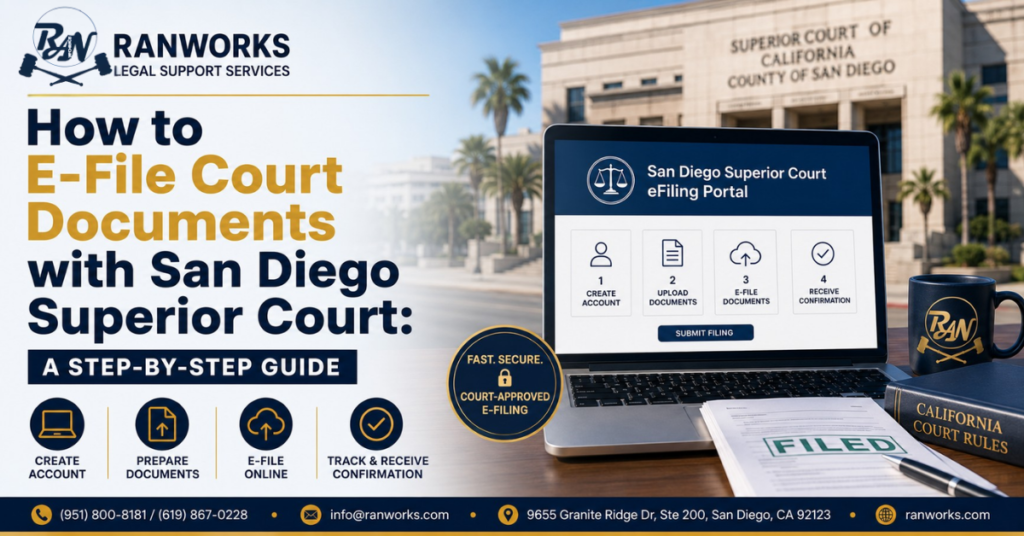
How to E-File Court Documents with San Diego Superior Court: A Step by Step Guide

Electronic filing has become the standard method for submitting court documents at San Diego Superior Court, and for good reason. When done correctly, it is faster, more reliable, and easier to track than physical delivery. But the process has specific requirements, and a rejected filing can cost you time and create compliance problems for an active case. This guide walks through exactly how e-filing works at San Diego Superior Court, what to prepare, what to avoid, and how an experienced court e-filing service in San Diego can manage the entire process on your behalf. Ranworks Legal Support Services has provided court document filing in San Diego attorneys depend on since 2002, handling e-filing, physical delivery, and same-day filing across all divisions of San Diego Superior Court and its branch locations. What Is E-Filing at San Diego Superior Court? E-filing, or electronic filing, is the process of submitting court documents through an approved online portal rather than delivering physical copies to the courthouse in person. San Diego Superior Court requires attorneys and filers to use a court-approved Electronic Filing Service Provider (EFSP) to submit documents electronically. The court does not accept direct uploads from individual computers. All e-filings must go through an approved EFSP that converts, checks, and transmits documents to the court’s case management system. The EFSP then returns a court-issued transaction confirmation and eFiling receipt to the filer once the court processes the submission. To e-file court documents with San Diego Superior Court, prepare your documents in PDF format, select a court-approved Electronic Filing Service Provider, create an account, upload your documents, pay the filing fee, and submit. The court processes most e-filings within 2 to 4 hours during business hours and returns an eFiling receipt with a transaction confirmation number upon acceptance. Which Case Types Can Be E-Filed at San Diego Superior Court? E-filing is available for most civil case types at San Diego Superior Court. Here is a quick reference: Case Type E-Filing Available Notes Civil (unlimited and limited) Yes Most civil matters accepted via e-filing portal Family Law Yes Including dissolution, custody, support filings Probate Yes Petitions, inventories, accountings Unlawful Detainer Yes Eviction filings handled electronically Small Claims Yes Plaintiffs and defendants can e-file Post-Judgment Matters Yes Wage garnishment, bank levy, and enforcement docs Criminal No (generally) Criminal filings typically require in-person submission If you are unsure whether your specific document type can be e-filed, the Ranworks court filing services San Diego team can confirm availability before submission to avoid wasted time or a rejected filing. Step by Step: How to E-File Court Documents at San Diego Superior Court Here is the complete process for e-filing at San Diego Superior Court, from document preparation through confirmation: Prepare your documents in PDF format. San Diego Superior Court requires text-searchable PDFs. Scanned images converted to PDF without OCR processing are frequently rejected. Each document should be a separate PDF file unless the court requires them combined. Confirm you are using a court-approved EFSP. San Diego Superior Court maintains a list of approved Electronic Filing Service Providers on its website. Only filings submitted through approved providers are accepted by the court’s system. Create an account with your selected EFSP if you do not already have one. You will need to provide basic contact and billing information. Some providers charge a registration fee; others do not. Enter the case information accurately. This includes the case number, case title, court division, and document type. Errors in case information are one of the most common causes of rejection. Upload your PDF documents through the EFSP portal. Confirm that each document is correctly labeled by type, such as summons, complaint, motion, or proof of service. Review the filing fee. Court fees vary by case type, document type, and relief requested. The EFSP should display the applicable fee before you confirm submission. Pay the filing fee through the EFSP. Most providers accept major credit cards and law firm accounts. Ranworks pays filing fees on your behalf and includes the total in the invoice returned to your office. Submit the filing and note the submission timestamp. The time of submission is legally significant for deadline purposes, not the time the court processes the filing. Wait for the court-issued eFiling receipt. San Diego Superior Court typically processes e-filings within 2 to 4 hours during court business hours. The receipt includes the court’s transaction ID and confirmation of acceptance. Retain the eFiling receipt and transaction confirmation for your records. Ranworks returns all filing receipts, transaction IDs, and rejection notices to the attorney or client immediately upon receipt from the court. Common E-Filing Rejections and How to Avoid Them Rejections delay your case and can create compliance problems if a deadline passes while the filing is being corrected. Here are the most common reasons San Diego Superior Court rejects e-filings and how to prevent each one: 1 Non-Searchable PDF The court requires text-searchable PDFs. A scanned document saved as a PDF without optical character recognition applied will be rejected. Always use a PDF creator that produces searchable text, or run OCR processing before uploading. 2 Incorrect Case Number or Division Case numbers must match the court’s records exactly. A transposed digit or an incorrect division code causes an immediate rejection. Double-check the case number from the court’s online case management system before submitting. 3 Missing or Incorrect Filing Fee Submitting without the correct filing fee, or submitting without any fee when one is required, results in rejection. Confirm the applicable fee for your specific document type before submission, since fees vary by case type and document category. 4 Wrong Document Format or Combination Some document types must be submitted separately. Combining documents that the court requires as individual files, or splitting documents that the court requires combined, causes processing errors. Confirm document requirements for your case type before uploading. 5 Filing Outside Court Hours E-filings submitted outside court business hours are timestamped for the submission time but may not be processed until the next business day. This

How to E-File Court Documents with San Diego Superior Court: A Step by Step Guide Read More »