affordable process server San Diego

The Complete Guide to Setting Up a Process Serving Retainer Agreement with a San Diego Vendor

A billing coordinator at a mid sized San Diego firm is closing out the quarter and staring at forty seven invoices from six different process servers, each formatted differently, each due on a different date, and none of them matching up cleanly against the cases they were supposed to cover. Nothing on any single invoice is wrong exactly. The problem is that reconciling six vendor relationships takes almost as much time as the legal work the invoices are supposed to support. A process serving retainer agreement law firm San Diego arrangement exists to solve exactly this kind of problem. Instead of negotiating pricing and terms case by case with whichever server happens to be available, a firm sets up one agreement covering the scope of process serving, pricing, documentation standards, and turnaround expectations for every matter sent during the term. This guide walks through what actually needs to go into that agreement before signing one with a San Diego vendor. The Short Answer: What a Process Serving Retainer Agreement Includes A process serving retainer agreement between a law firm and a San Diego vendor typically defines the scope of services covered, volume based pricing instead of per case rates, documentation standards that apply to every matter, turnaround expectations for standard versus rush service, and how invoicing is consolidated across the billing period. The agreement should also address what happens when case volume exceeds what was originally expected, so neither side is caught off guard mid term. Why Firms Move From Per Case Billing to a Retainer Structure Per case billing feels simple at low volume because each invoice is small and easy to check against a single matter. That simplicity disappears once a firm is sending enough cases that the billing department is reconciling a dozen or more invoices a month from the same handful of vendors. A retainer structure replaces that pattern with one negotiated set of terms that applies to every case sent during the agreement, which means pricing, documentation format, and invoicing schedule are all settled once rather than renegotiated with every new matter. What to Define Before Drafting the Agreement Before any terms get written down, a firm needs internal clarity on a few things. What types of documents will actually be sent under this agreement, summons and complaints, subpoenas, family law papers, or all of the above. Which offices or attorneys are authorized to submit cases directly to the vendor. Whether skip tracing and court filing should be included under the same agreement or handled separately. Getting internal agreement on these questions before drafting saves a round of renegotiation later when the vendor asks the same questions from the other side. Setting Volume Expectations and Pricing Terms Pricing under a retainer works differently than a simple per case rate card. A vendor needs a reasonable estimate of expected monthly volume to offer meaningful pricing, since a rate built for ten cases a month does not make sense for a firm sending fifty. An affordable process server San Diego retainer typically ties pricing tiers to volume bands, so a firm that grows into a higher tier during the term gets pricing that reflects the new volume rather than sticking with a rate negotiated for a smaller caseload. The agreement should specify how often volume gets reviewed and what happens if actual case flow consistently falls outside the tier that was negotiated. Documentation Standards to Include in the Agreement A retainer agreement is also the place to lock in documentation requirements rather than leaving them to whatever the assigned server happens to produce. This should specify that every attempt, successful or not, gets documented with GPS coordinates and a time stamp, that affidavits follow a consistent format regardless of which server on the vendor’s team handled the case, and that proof of service meets the standard a professional process server California partner should already be following under state requirements. California’s own guidance, published through the California Courts Self Help Center, outlines a useful baseline for what that documentation needs to include. Firms can also confirm a vendor’s business standing directly through the California Secretary of State before finalizing a retainer. Spelling this out in the agreement itself, rather than assuming it, gives the firm something to point to if documentation quality ever slips. Handling Overflow Cases and Rush Service Under a Retainer No retainer agreement anticipates every situation perfectly. A well drafted agreement addresses what happens when a firm sends more cases in a given month than the negotiated volume assumed, whether that triggers automatic overflow pricing or simply gets absorbed until the next volume review. It should also spell out how rush and expedited service get priced under the retainer, since these situations come up regularly enough that leaving them undefined creates friction exactly when a firm can least afford delay over a pricing dispute. Important: Firms that leave rush pricing undefined in a retainer agreement often find out the actual terms only when they need rush service urgently, which is the worst possible time to discover a disagreement over cost. Comparing Per Case Billing to a Retainer Agreement Aspect Per Case Billing Retainer Agreement Pricing Negotiated for every matter Set for the full term based on volume Invoicing Separate invoice per case One consolidated invoice on a schedule Documentation Varies by assigned server Standards written into the contract Volume changes No defined process Reviewed and adjusted at set intervals Rush service pricing Negotiated case by case Defined in advance within the agreement Common Terms to Negotiate Before Signing A few terms deserve specific attention before a firm signs. Length of the agreement and renewal terms, since a one year term with automatic renewal behaves differently than a month to month arrangement. Termination notice period, so the firm knows how much runway it has if the relationship needs to end. Exactly which services, including process serving, skip tracing, and court filing, fall under the retainer versus which get billed separately. And a clear definition of what counts as a completed service for billing purposes, since disputes over
The Complete Guide to Setting Up a Process Serving Retainer Agreement with a San Diego Vendor Read More »

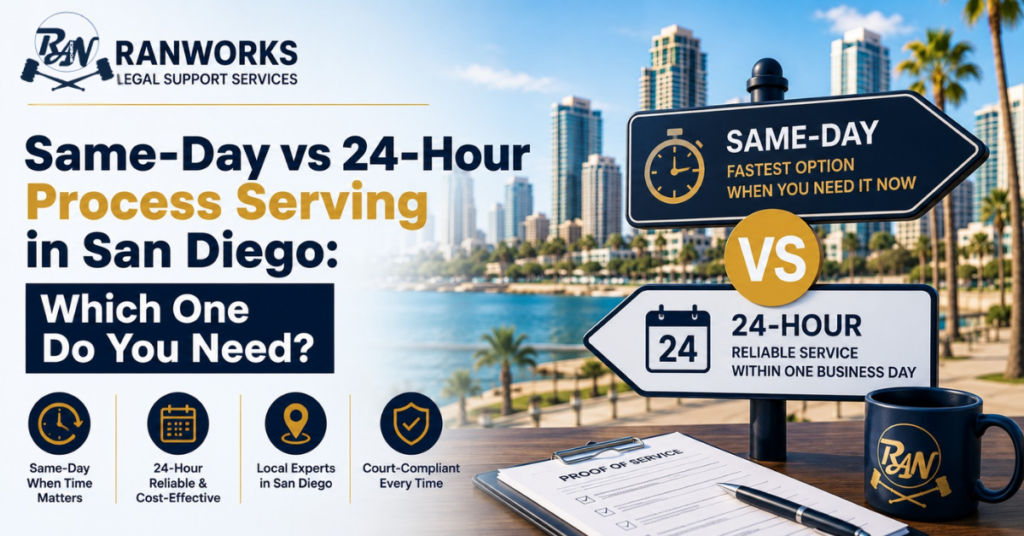
Same Day vs 24 Hour Process Serving in San Diego: Which One Do You Need?

When a deadline is approaching fast, the difference between same day and 24 hour process serving in San Diego is not just a matter of speed. It affects cost, logistics, and whether your case can proceed on the timeline you need. If you are searching for a process server near me in San Diego because something urgent has come up, this guide breaks down both options clearly so you can make the right call quickly without guessing. Ranworks Legal Support Services has provided same day and 24 hour process serving across San Diego County for over 23 years. Here is exactly how both options work and when each one is the right fit. The Quick Answer: Same Day vs 24 Hour Process Serving A same day process server in San Diego is dispatched immediately and completes service within the same business day, used for the most urgent situations like hearings tomorrow or restraining orders that must be served today. A 24 hour process server in San Diego completes service within approximately one full day, suited for urgent filings where same-day dispatch is not strictly necessary but standard turnaround is too slow. Both options include GPS tracked documentation and court ready Proof of Service affidavits. What Is a Same Day Process Server in San Diego? A same day process server in San Diego is dispatched as soon as the assignment is received and prioritized above all other cases in queue. The goal is to complete at least one service attempt, and ideally successful service, before the end of the same business day. Same day service is the option most people mean when they search for an emergency process server in San Diego. It is reserved for situations where the urgency is real and any delay, even by one day, could have consequences for the case. What same day process serving in San Diego includes: Immediate dispatch upon receipt of the assignment and documents Priority status above all standard and rush queue assignments GPS tracked documentation on the attempt with an exact timestamp Real-time status update to the attorney or client after the attempt Court ready Proof of Service affidavit prepared for same-day or next-morning filing Important: Same day service requires that documents and recipient information are submitted to Ranworks as early in the business day as possible. Assignments received late in the afternoon may not allow enough time for same-day completion depending on the recipient’s location within San Diego County. What Is a 24 Hour Process Server in San Diego? A 24 hour process server in San Diego operates on an expedited basis with a target of completing service within approximately one full day of receiving the assignment. This option sits between same-day urgency and the standard 3 to 5 business day turnaround. For most urgent but not immediately critical situations, a 24 hour process server in San Diego is the most practical and cost-effective choice. It provides meaningful speed without the premium cost of same-day emergency dispatch. What 24 hour process serving in San Diego includes: High-priority assignment status processed ahead of standard queue Attempt made within the following business day of assignment receipt GPS tracked documentation on all attempts Court compliant Proof of Service with timestamps and location data Status update after each attempt Same Day vs 24 Hour vs Standard: Full Comparison Here is a direct side-by-side comparison of all three service tiers available from Ranworks for process serving San Diego CA clients: Feature Same Day Service 24 Hour Service Standard Service Turnaround Within same business day Within approximately 24 hours 3 to 5 business days Best For Restraining orders, imminent hearings Urgent filings with next-day deadline Routine civil litigation Dispatch Priority Immediate High priority same day queue Scheduled rotation Relative Cost Highest tier Mid-level add-on fee Base rate GPS Documentation Included Included Included Proof of Service Court ready affidavit Court ready affidavit Court ready affidavit Available at Ranworks Yes Yes Yes When to Choose a Same Day Process Server in San Diego Same day process serving is the right call in any of these situations: 1 Hearing Scheduled for Tomorrow Morning If a court hearing is set for the following morning and the opposing party has not yet been served, same day service is the only option that can realistically complete service in time. Courts require proof of service before a hearing can proceed in most cases. 2 Restraining Order That Must Be Served Immediately Temporary restraining orders often come with a specific timeframe in which service must be completed before the order takes effect or before the hearing on the permanent order. Same day emergency process server San Diego dispatch is the standard approach for these assignments. 3 Statute of Limitations Expiring Within 24 Hours If a deadline is within hours and service has not been completed, same day process serving is the only viable option. Acting early in the day gives the server the best chance of completing service before the window closes. 4 Last Minute Subpoena for a Deposition Starting Tomorrow Deposition subpoenas sometimes need to be served at the last possible moment due to scheduling changes or late decisions. Same day service covers this situation when the deposition date leaves no room for standard turnaround. When a 24 Hour Process Server in San Diego Is the Better Choice A 24 hour process server in San Diego is the smarter choice when urgency is real but true same-day completion is not strictly required. This option saves money while still moving significantly faster than standard service. 1 Hearing in 48 Hours With Documents Ready Now If a hearing is two days away and documents are ready to be assigned today, 24 hour service provides a comfortable completion window without the premium cost of same-day emergency dispatch. 2 Urgent Filing With a Next Business Day Deadline When a next-day deadline exists but the matter is not a true emergency, 24 hour service keeps the case on track at a more affordable rate than same-day. 3

Same Day vs 24 Hour Process Serving in San Diego: Which One Do You Need? Read More »

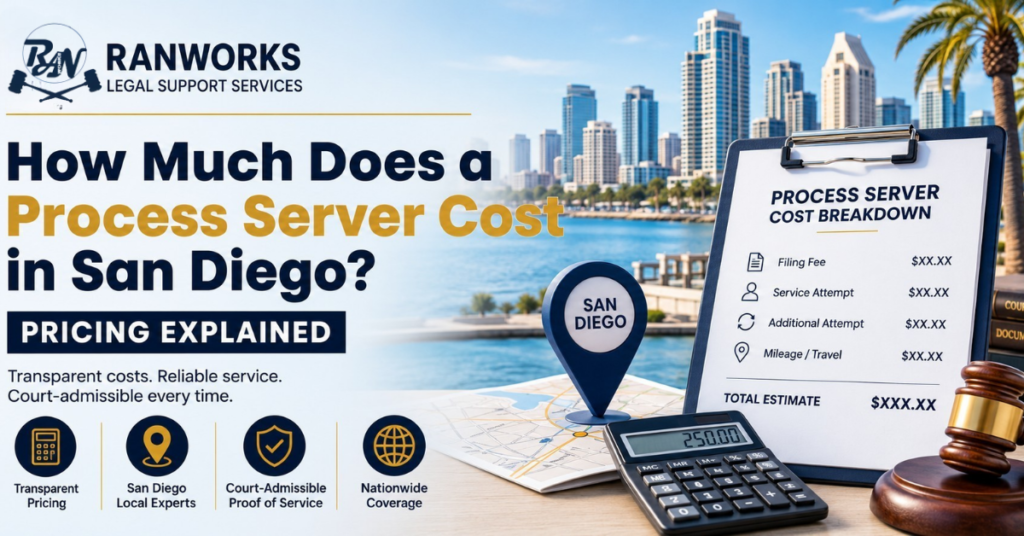
How Much Does a Process Server Cost in San Diego? Pricing Explained

Process serving is one of those services most people know they need but have no idea what it costs until they start searching. If you are looking for a process server in San Diego, whether for a one-time filing or regular legal support for your practice, this guide gives you a clear, honest breakdown of what to expect to pay and why. Ranworks Legal Support Services has provided process serving San Diego CA clients depend on since 2002. This guide is written from real experience handling tens of thousands of assignments across San Diego County, with the goal of giving you the most useful and transparent pricing overview available. What Does a Process Server Cost in San Diego? A process server in San Diego typically charges between $75 and $125 for standard service, depending on the location within the county. Rural, remote, or higher-travel areas cost more than metro San Diego addresses. Faster turnaround options, including rush, expedited, and same-day service, carry additional fees on top of the base rate. A process server in San Diego costs roughly $75 to $125 for standard service, depending on the address location within the county. Rush service adds approximately $50, expedited service adds around $125, and same-day emergency service is quoted on a case-by-case basis. Additional fees apply for skip tracing when a recipient needs to be located first. What Affects the Cost of Process Serving in San Diego? Not every assignment in San Diego costs the same. Here are the main variables that determine what you will pay: 1 Location Within San Diego County San Diego County covers over 4,200 square miles, from downtown San Diego to rural East County communities like Alpine, Jamul, and Pine Valley. Metro addresses close to central San Diego are typically priced at the lower end. Addresses in North County, South County, or the far East County areas, which require more travel time, are priced higher. 2 Turnaround Speed Standard service costs less than rush, expedited, or same-day service. The faster the turnaround required, the more priority resources are needed to complete the assignment, which is reflected in the fee. 3 Number of Parties and Addresses Process serving is priced per party, per address, per document. A case with one defendant at one address costs less than a case with three defendants at different locations across the county. 4 Whether Skip Tracing Is Required If the recipient’s address is unknown, outdated, or the person appears to be avoiding service, skip tracing is required before service can be attempted. This is a separate service billed in addition to the process serving fee. 5 Number of Attempts Needed Most pricing covers an agreed number of attempts. If service requires an unusually high number of attempts due to an evasive recipient, additional attempt fees may apply beyond what is included in the base rate. Standard, Rush, Expedited, and Same Day Process Server Pricing in San Diego Here is how the main service tiers at Ranworks break down in terms of turnaround and cost structure: Service Type Typical Turnaround What It Covers Standard Service 3 to 5 business days First attempt at stated address, GPS documented Proof of Service Rush Service Within 72 hours Priority dispatch with same GPS documentation, add-on fee applies Expedited Service Within 24 hours Faster dispatch for time-sensitive filings, higher add-on fee applies Same Day / Emergency Same business day Immediate dispatch for restraining orders, urgent hearings Skip Tracing Add-On 24 to 48 hours Locating current address when recipient has moved or is unavailable Rush service adds $50 to the base rate. Expedited service adds $125. Same-day emergency service is quoted directly based on the specific situation. These fees apply per party, per address. What Is Included in the Base Rate? When you hire an affordable process server in San Diego from Ranworks, the base rate includes: Multiple attempts at different times of day at the stated address GPS tracked documentation on every attempt, successful or not A court compliant Proof of Service affidavit with location coordinates, timestamps, and a signed declaration under penalty of perjury Status updates after each attempt so you know exactly what is happening E-filing support available once service is complete There are no hidden fees for GPS tracking or documentation. These are standard with every assignment, not add-ons. What Costs Extra Beyond the Base Rate? Certain situations require additional services beyond standard process serving. Here is what typically carries an added cost: Rush service: $50 added to the base rate for 72-hour turnaround Expedited service: $125 added to the base rate for 24-hour turnaround Same-day emergency service: quoted individually based on the specifics Skip tracing: priced separately when a current address needs to be located Addresses outside standard San Diego County coverage: priced based on location Note: Always ask for a written quote before any assignment begins. A reputable affordable process server San Diego provider confirms all fees upfront and in writing so there are no surprises once the work is underway. Affordable vs Cheap: How to Compare Process Servers on Value Searching for a process server near me in San Diego often returns a mix of providers at very different price points. The lowest-priced option is not always the most cost-effective choice when you factor in the risk of defective service. Here is a quick reference for evaluating value when comparing providers: What to Check Red Flag Green Flag Registration Cannot confirm county registration Provides registration number on request Bond Vague or unable to confirm Bonded and confirms it in writing Documentation Basic handwritten affidavit only GPS tracked, time stamped Proof of Service Pricing Clarity Quote changes after work starts Written quote confirmed before starting Communication Hard to reach after assignment begins Status updates after every attempt Experience Newly started, no local track record 23+ years serving San Diego County A Proof of Service that gets challenged in court because of poor documentation can delay your case and require service to be repeated, which costs far more than the difference

How Much Does a Process Server Cost in San Diego? Pricing Explained Read More »