
How San Diego Law Firms Can Partner with a Process Serving Company for Bulk Case Management
See how San Diego law firms partner with one process serving company for bulk case management, consistent GPS documentation, and one invoice.
See how San Diego law firms partner with one process serving company for bulk case management, consistent GPS documentation, and one invoice.
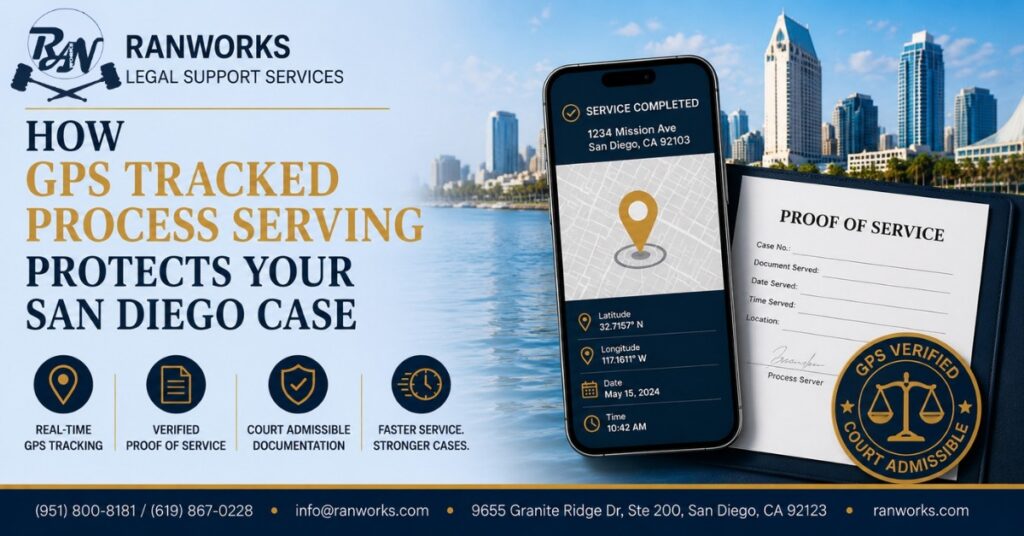
How GPS Tracked Process Serving Protects Your San Diego Case | Ranworks A signed Proof of Service used to be enough on its own. In most cases it still is. But when a defendant disputes that they were ever served, or claims the server was never at the stated address, an attorney needs more than a signature to win that argument. This is where a GPS tracked process server in San Diego makes a real difference. This guide explains what GPS tracked process serving actually involves, why it matters for your case, and what attorneys and law firms should expect from this level of documentation. What Is GPS Tracked Process Serving? GPS tracked process serving means that every attempt to deliver legal documents is logged with verified location data and a timestamp, captured at the exact moment of the attempt. Instead of relying only on a server’s written recollection, the documentation includes objective, location verified evidence. This applies whether the attempt is successful or not. Each visit to an address, whether the door opens or not, becomes part of a documented record tied to a specific place and time. Why Use a GPS Tracked Process Server in San Diego? Attorneys and law firms in San Diego increasingly ask for GPS tracked service because it directly reduces the risk of a successful challenge to service of process. Here is what GPS tracking adds to a standard Proof of Service: Verified coordinates confirming the server was physically present at the address An automatic timestamp that cannot be altered after the fact A documented history of every attempt, not just the final successful one Stronger support for substituted service when personal service repeatedly fails Reduced reliance on the server’s memory or handwritten notes weeks after the event A GPS tracked process server in San Diego is used because the location data and timestamps captured during each attempt provide objective proof of where and when service occurred. This strengthens the Proof of Service and makes it significantly harder for opposing counsel to successfully challenge service in court. GPS Tracking vs Traditional Process Serving Documentation The difference becomes clear when comparing how each approach holds up under scrutiny. Documentation Type Without GPS Tracking With GPS Tracking Location Proof Server’s written statement only Verified coordinates at time of service Timestamp Accuracy Manually recorded Automatically logged Court Challenge Risk Higher Lower Diligent Attempt Record Relies on memory and notes Time stamped attempt history Credibility in Disputes Server’s word against defendant’s Objective data supports the affidavit Attorney Confidence Variable Consistently strong Traditional documentation is not inherently invalid. Courts have accepted handwritten Proofs of Service for decades. But when a case becomes contentious, GPS verified data gives attorneys a meaningfully stronger position than a server’s recollection alone. How GPS Data Holds Up When Service Is Challenged in Court When opposing counsel files a motion to quash service, the court looks at the credibility and completeness of the Proof of Service. A defendant might claim they were never approached at that address, or that the encounter happened on a different day. With GPS tracked documentation, the server’s affidavit is supported by coordinates and a timestamp that align with the claimed time and location of service. This does not just support the server’s word, it gives the court an objective data point that is difficult to dispute without contrary evidence of its own. Important: GPS data strengthens a Proof of Service but does not replace the legal requirements for diligent attempts or proper method of service. Attorneys should still ensure the correct service method, whether personal or substituted, was used and properly documented. Why This Matters Even More for Evasive Recipients Some cases involve a recipient who is actively avoiding service. This often requires multiple attempts at different times of day, sometimes at different locations such as a home and a workplace. Each of these attempts matters if the case later requires a motion for substituted service or service by publication. GPS tracked attempts create a clear pattern showing genuine, diligent effort. Rather than a vague summary of how many times someone tried, the court sees a specific record of dates, times, and locations, which directly supports the legal standard for diligence required before alternative service methods are approved. What Attorneys and Law Firms Should Look for in GPS Documentation Not all process servers offer the same quality of GPS documentation. When evaluating a process server for law firms in San Diego, attorneys should confirm the following: Coordinates are captured automatically at the time of the attempt, not added manually afterward Timestamps are tied directly to each attempt and included in the final Proof of Service Documentation includes both successful and unsuccessful attempts The affidavit format meets California Rules of Court standards for direct filing The server can speak to the documentation if called to testify regarding service How Ranworks Delivers GPS Tracked Process Serving in San Diego Ranworks Legal Support Services has provided process serving San Diego CA attorneys and law firms rely on since 2002. Every assignment, regardless of outcome, includes GPS verified location data and a timestamp for each attempt. What this looks like in practice for our clients: Every attempt, successful or not, is logged with GPS coordinates and the exact time Proof of Service affidavits include this data formatted for direct court filing Attorneys receive status updates after each attempt without needing to follow up Documentation supports motions for substituted service when diligent attempts are required Coverage extends throughout all of San Diego County, from downtown to rural East County addresses For full details on coverage areas, turnaround times, and pricing, visit our process server San Diego service page. Need service of process backed by verified documentation your case can rely on? Visit our process server San Diego page to review coverage and pricing, or call 888-636-0293 to discuss your case with our team. Frequently Asked Questions Why use a GPS tracked process server in San Diego? A GPS tracked process server in San Diego
How GPS Tracked Process Serving Protects Your San Diego Case Read More »

How to Serve Legal Documents in San Diego: A Step by Step Guide for Attorneys | Ranworks Service of process is one of those tasks that looks simple on paper and becomes complicated the moment a defendant does not want to be found. For attorneys managing active caseloads in San Diego, getting service right the first time saves weeks of delay and protects the case from a procedural challenge later. This guide walks through exactly how to serve legal documents in San Diego, the rules attorneys need to follow, and where a dedicated process server for attorneys in San Diego fits into the workflow. Why Proper Service of Process Matters for Attorneys A case cannot move forward until the court is satisfied that the opposing party received proper notice. If service is done incorrectly, defective, or undocumented, opposing counsel can file a motion to quash service — which stalls the case and can damage your credibility with the court. For attorneys, this makes service of process a risk management issue, not just an administrative task. The stakes are higher in time-sensitive matters such as restraining orders, unlawful detainer actions, and cases approaching a statute of limitations deadline. How Do I Serve Legal Documents in San Diego? The Step-by-Step Process Attorneys often ask how do I serve legal documents in San Diego when managing a new filing. The process follows a consistent legal sequence under the California Code of Civil Procedure, regardless of case type. Step Action 01 File the initial documents with San Diego Superior Court and obtain the case number 02 Identify the correct party to be served and confirm their last known address 03 Select a process server for attorneys in San Diego who is registered with the county 04 Provide the server with the documents, recipient details, and any deadline constraints 05 The server attempts personal service, varying time of day if needed 06 If personal service fails after diligent attempts, substituted service may be used 07 The server documents every attempt with date, time, location, and outcome 08 A signed Proof of Service is prepared and returned to the attorney 09 The Proof of Service is filed with the court, electronically or in person To serve legal documents in San Diego, file your case with the court, confirm the recipient’s address, then hire a registered process server to attempt personal delivery. If personal service is unsuccessful after diligent attempts, substituted service may apply. The server documents each attempt and prepares a signed Proof of Service, which is then filed with the court to confirm the case can proceed. Who Can Legally Serve Documents in San Diego? In California, several parties are permitted to serve legal documents — but not all options are advisable for attorneys managing active litigation. Registered process servers, who are bonded and experienced with court requirements The county sheriff, who can serve documents for a fee but often has longer turnaround times Any adult who is not a party to the case, in limited situations Attorneys themselves and their staff generally cannot serve documents in their own case, since California law requires the server to be a neutral, non-party adult. This is one reason most law firms rely on a dedicated process server for attorneys in San Diego rather than attempting service in-house. Choosing the Right Method of Service for Your Case Not every case calls for the same approach. Attorneys should match the service method to the urgency and nature of the matter. Personal Service Best for most civil litigation, family law filings, and any case where the recipient’s address is confirmed and stable. This is the most defensible method in court. Substituted Service Used when personal service repeatedly fails. Requires documented diligent attempts before this method becomes valid. Courts expect to see a clear attempt history before accepting substituted service. Service by Publication Reserved for situations where the recipient genuinely cannot be located despite a thorough search, including skip tracing. Requires court approval and is typically the slowest method. Important for attorneys: Substituted service and service by publication both require proof of diligent effort. Working with a process server for attorneys in San Diego who documents every attempt with GPS data and timestamps gives you a stronger record if the method of service is ever challenged. Common Mistakes Attorneys Should Avoid When Serving Documents 1 Waiting Too Long to Initiate Service Statutes of limitations and court deadlines do not pause for a slow start. Initiating service as soon as the case is filed gives more room to handle an evasive defendant or address issues that arise. 2 Using an Unregistered Server If the server is not properly registered in California, the validity of service can be challenged — even if the documents were technically delivered. Always confirm registration status before assigning service. 3 Incomplete Proof of Service A Proof of Service missing required details — such as physical description, exact time, or method of service — can be rejected by the court or challenged by opposing counsel. 4 Not Documenting Failed Attempts If a case eventually requires substituted service or a motion for alternative service, the court wants to see a documented history of attempts. Skipping this step weakens your position later. 5 Overlooking Skip Tracing When the Address Is Bad If the recipient no longer lives at the known address, continuing to attempt service there wastes time. Skip tracing should be used early to confirm a current address. What to Do When Service of Process Is Challenged If opposing counsel files a motion to quash service, attorneys need a complete and credible record to respond. This includes the Proof of Service, attempt logs with timestamps, and any supporting documentation such as GPS data or photographs from the process server. A process server for attorneys in San Diego who provides GPS-tracked documentation on every attempt gives attorneys a stronger position when defending the validity of service in front of a judge. Why Law Firms Rely on a Process Server for
How to Serve Legal Documents in San Diego: A Step by Step Guide for Attorneys Read More »