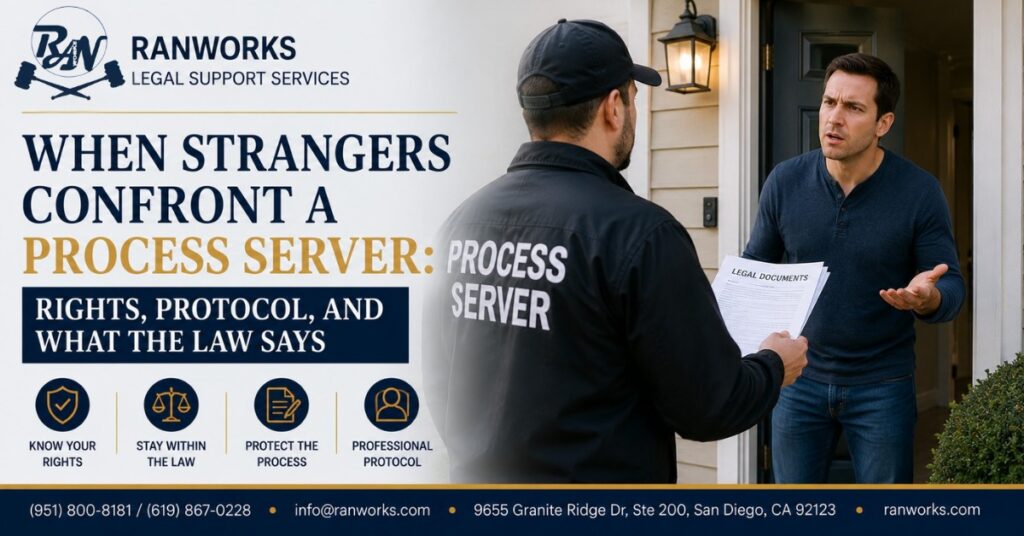
When Strangers Confront a Process Server: Rights, Protocol, and What the Law Says
Process Servers in Gated Communities: California Law Most people who live in a gated community have no reason to think about how legal documents get delivered inside those gates. That changes the moment a lawsuit, subpoena, or restraining order names someone at that address. A recent Ranworks assignment in San Diego County shows how fast a routine attempt can shift. A server entered a gated community lawfully, found the subject not home, and while exiting was confronted by two residents with no connection to the case. They photographed her credentials, referenced being armed, and challenged her right to be there. She identified herself, disengaged, and waited outside for law enforcement. The service was not completed that day. The case record stayed clean. This is not an unusual story. Confrontations with neighbors, bystanders, and strangers happen on residential streets, at apartment complexes, and inside gated communities. For active California servers, these situations are not uncommon. This guide covers what the law says about these situations and what good protocol looks like when they arise. A Process Server’s Right to Be There California law is clear on this point. A registered process server is allowed to enter a staffed gated community to deliver legal documents. All they need to do is show valid identification and proof of their current registration. The gate guard or security personnel must provide reasonable access after the registered process server presents valid identification and proof of current registration. This is covered under California Code of Civil Procedure Section 415.21, and the full text is available on the California Legislative Information website. This right was expanded in 2020 to cover apartment buildings with three or more units and condo complexes with four or more units. The thinking behind the law is straightforward: living in a gated community does not put anyone beyond the reach of the courts. Two things have to be true for this law to apply. The server must be currently registered as a process server in California. And there must be an actual person staffing the gate at the time of the attempt. If the gate runs on an automated system with no guard present, this law does not apply, and the server has to find another way in or explore other options. When a Neighbor, Bystander, or Stranger Confronts the Server The person being served is often not the one who creates a difficult situation; it is the people around them. At a house, it might be a partner or roommate who comes to the door ready for a fight. At an apartment building, it could be a neighbor who sees what is happening and decides to get involved. At a gated community, it looks like what happened to the Ranworks server in San Diego: residents with no stake in the matter who photographed her credentials, referenced being armed, and challenged her right to be on the property. On a residential street, it might be a stranger who watched the server park, followed them to the door, and decided their presence needed explaining. Every one of these situations calls for the same response: State who you are and why you are there. If the confrontation continues, stop engaging and move away from the immediate area. Do not argue, do not try to push through, and do not stay on scene if the situation feels unsafe. Document everything before leaving the area. Contact law enforcement if threats are made. The San Diego server did exactly this. She said what needed to be said, recognized the situation was not going to resolve itself, and waited outside the gate for law enforcement rather than re-entering the property. What she did not do matters just as much. She did not raise her voice. She did not debate her right to be there beyond stating it once. She did not go back in. And before leaving, she documented everything. From a legal standpoint, none of these people, whether a neighbor, a bystander, or a stranger at the door, have any authority to stop a registered process server from completing a lawful delivery. Blocking, detaining, threatening, or physically interfering with a lawful process server may expose the individual to civil liability or, depending on the circumstances, criminal consequences. The emotional weight of what is being served, whether a divorce filing, a restraining order, or a civil judgment, sometimes spills onto the people nearby. That is a reality of the job. It is not a reason to engage. The goal in every confrontation is the same: leave the scene safely, and leave the case record clean. Why Documentation Decides the Outcome When a serve gets interrupted or contested, the notes from that day become the official record. GPS coordinates showing exactly where the server was, a timestamped log of what happened, and a written account of who was present and what was said: all of that becomes part of the file. Ranworks documents every attempt with GPS coordinates, timestamped notes, and a full written account of what the server observed. That level of detail matters directly for process serving services in California because a contested attempt with solid documentation is a very different situation from a contested attempt with a one-line note. If opposing counsel later questions whether service was handled properly, the documentation is what answers that question. GPS records are particularly useful because they verify the server’s location independently of anything the server wrote down. GPS-backed documentation can provide powerful corroborating evidence showing where and when a service attempt occurred. When the Attempt Cannot Be Completed Sometimes a gated community attempt does not work out on the first visit, or the second. When that happens, there are other options. In Bein v. Brechtel-Jochim Group, Inc. (1992), a California appellate court upheld substituted service through a gated community’s security personnel after access to the defendant was denied. The case remains an important authority when defendants use controlled-access communities to frustrate service attempts. That requires going back to court for
When Strangers Confront a Process Server: Rights, Protocol, and What the Law Says Read More »