
How San Diego Law Firms Can Partner with a Process Serving Company for Bulk Case Management
See how San Diego law firms partner with one process serving company for bulk case management, consistent GPS documentation, and one invoice.
See how San Diego law firms partner with one process serving company for bulk case management, consistent GPS documentation, and one invoice.

One of the most common frustrations in civil litigation is when service of process stalls because a recipient cannot be found or is clearly avoiding service. It happens regularly in divorce cases, debt collection matters, restraining order filings, and civil disputes of all kinds. The good news is that process serving San Diego CA attorneys and individuals depend on does not simply stop when the first attempt fails. California law provides a structured series of options that give creditors, attorneys, and petitioners a clear path forward even when a recipient is evasive or missing. Ranworks Legal Support Services has handled thousands of difficult service assignments throughout San Diego County over 23 years. This guide walks through exactly what happens at each stage when standard service cannot be completed. The Short Answer: Failed Service Does Not Mean Your Case Is Over If a process server cannot serve someone in San Diego, California law provides several options depending on the situation. The server makes additional attempts at different times, uses skip tracing to locate a current address if needed, and may proceed with substituted service after diligent attempts are documented. If all standard methods fail, the court can approve alternative service methods including service by publication. A failed first attempt does not stop a case from moving forward. Step 1: Additional Attempts at Different Times A single failed attempt is rarely the end of the process. A professional process server in San Diego will vary the day and time of each attempt to account for work schedules, routines, and travel patterns. Best practice for process serving in San Diego CA assignments includes attempts at different times such as early morning before work, midday, early evening, and weekends. This approach maximizes the chance of catching the recipient at home or at a regular location. Each attempt is logged with a GPS verified timestamp so there is a documented record of diligence if the case later requires an alternative service method. Step 2: Skip Tracing to Find a Current Address If the recipient is no longer at the known address, has moved without notice, or the address on file turns out to be incorrect, the next step is skip tracing. Skip tracing is a professional investigative process that searches available records to locate a current address, workplace, or other confirmed location for the recipient. Common reasons skip tracing becomes necessary in San Diego cases include: The recipient moved after the case was filed The address on file was always incorrect The recipient is staying at a secondary location to avoid service The recipient’s employer has changed Ranworks provides skip tracing services alongside process serving in San Diego CA assignments, so clients do not need to coordinate separately with a different provider. Once a verified address is confirmed, service attempts resume immediately. Step 3: Substituted Service Under California Law If personal service cannot be completed after diligent attempts at both home and workplace addresses, California Code of Civil Procedure Section 415.20 allows for substituted service. This means leaving the documents with a responsible adult at the recipient’s home or workplace, followed by mailing a copy to the same address. Courts expect to see documented evidence of diligent attempts before substituted service is accepted. This is why GPS tracked attempt logs are critical. Without a clear record of attempts, opposing counsel can challenge the validity of substituted service. Important: Substituted service requires proof of diligent effort before it is valid. The court will look at how many attempts were made, at what times, and at which addresses. Ranworks provides complete GPS verified attempt logs that satisfy this standard. Step 4: Emergency Process Server in San Diego for Urgent Deadlines Some situations do not allow for the standard timeline of multiple attempts spread across several days. If your case involves an upcoming hearing, a restraining order that needs to be served before a court date, or any other time-sensitive deadline, an emergency process server in San Diego can be dispatched for same-day or 24 hour service. A 24 hour process server in San Diego from Ranworks operates on an expedited basis, prioritizing urgent assignments above standard queue. Same-day emergency service is available for the most time-critical matters. When to request emergency service: If your hearing is within 72 hours, if a restraining order must be served before it takes effect, or if a statute of limitations is about to run out and service has not yet been completed, contact Ranworks immediately at 888-636-0293 for emergency dispatch. Step 5: Motion for Alternative Service Approved by the Court If all standard methods, including multiple personal service attempts, skip tracing, and substituted service attempts, have failed and been properly documented, an attorney can file a motion with the court requesting permission to use an alternative method of service. The court reviews the documented history of attempts and, if satisfied that diligent effort has been made, may approve an alternative such as service by email, social media, or posting. This requires a formal court order and cannot be done without judicial approval. The strength of this motion depends heavily on the quality and completeness of the attempt documentation. A process server near me in San Diego who provides GPS verified logs with timestamps for every attempt gives attorneys the strongest possible foundation for this motion. Step 6: Service by Publication as a Last Resort Service by publication is the option of final resort when a recipient genuinely cannot be located despite thorough and documented efforts. Under California Code of Civil Procedure Section 415.50, a court may authorize service by publishing a notice in a newspaper of general circulation in the area where the defendant was last known to reside. This method is rarely used because it requires court approval, takes time, and involves publication costs. Courts also require strong evidence that all other options were genuinely exhausted before granting this authorization. It is most commonly seen in dissolution of marriage cases where a spouse has completely disappeared. Why Documented Attempt
What Happens If a Process Server Cannot Serve Someone in San Diego? Read More »

Process serving is one of those services most people know they need but have no idea what it costs until they start searching. If you are looking for a process server in San Diego, whether for a one-time filing or regular legal support for your practice, this guide gives you a clear, honest breakdown of what to expect to pay and why. Ranworks Legal Support Services has provided process serving San Diego CA clients depend on since 2002. This guide is written from real experience handling tens of thousands of assignments across San Diego County, with the goal of giving you the most useful and transparent pricing overview available. What Does a Process Server Cost in San Diego? A process server in San Diego typically charges between $75 and $125 for standard service, depending on the location within the county. Rural, remote, or higher-travel areas cost more than metro San Diego addresses. Faster turnaround options, including rush, expedited, and same-day service, carry additional fees on top of the base rate. A process server in San Diego costs roughly $75 to $125 for standard service, depending on the address location within the county. Rush service adds approximately $50, expedited service adds around $125, and same-day emergency service is quoted on a case-by-case basis. Additional fees apply for skip tracing when a recipient needs to be located first. What Affects the Cost of Process Serving in San Diego? Not every assignment in San Diego costs the same. Here are the main variables that determine what you will pay: 1 Location Within San Diego County San Diego County covers over 4,200 square miles, from downtown San Diego to rural East County communities like Alpine, Jamul, and Pine Valley. Metro addresses close to central San Diego are typically priced at the lower end. Addresses in North County, South County, or the far East County areas, which require more travel time, are priced higher. 2 Turnaround Speed Standard service costs less than rush, expedited, or same-day service. The faster the turnaround required, the more priority resources are needed to complete the assignment, which is reflected in the fee. 3 Number of Parties and Addresses Process serving is priced per party, per address, per document. A case with one defendant at one address costs less than a case with three defendants at different locations across the county. 4 Whether Skip Tracing Is Required If the recipient’s address is unknown, outdated, or the person appears to be avoiding service, skip tracing is required before service can be attempted. This is a separate service billed in addition to the process serving fee. 5 Number of Attempts Needed Most pricing covers an agreed number of attempts. If service requires an unusually high number of attempts due to an evasive recipient, additional attempt fees may apply beyond what is included in the base rate. Standard, Rush, Expedited, and Same Day Process Server Pricing in San Diego Here is how the main service tiers at Ranworks break down in terms of turnaround and cost structure: Service Type Typical Turnaround What It Covers Standard Service 3 to 5 business days First attempt at stated address, GPS documented Proof of Service Rush Service Within 72 hours Priority dispatch with same GPS documentation, add-on fee applies Expedited Service Within 24 hours Faster dispatch for time-sensitive filings, higher add-on fee applies Same Day / Emergency Same business day Immediate dispatch for restraining orders, urgent hearings Skip Tracing Add-On 24 to 48 hours Locating current address when recipient has moved or is unavailable Rush service adds $50 to the base rate. Expedited service adds $125. Same-day emergency service is quoted directly based on the specific situation. These fees apply per party, per address. What Is Included in the Base Rate? When you hire an affordable process server in San Diego from Ranworks, the base rate includes: Multiple attempts at different times of day at the stated address GPS tracked documentation on every attempt, successful or not A court compliant Proof of Service affidavit with location coordinates, timestamps, and a signed declaration under penalty of perjury Status updates after each attempt so you know exactly what is happening E-filing support available once service is complete There are no hidden fees for GPS tracking or documentation. These are standard with every assignment, not add-ons. What Costs Extra Beyond the Base Rate? Certain situations require additional services beyond standard process serving. Here is what typically carries an added cost: Rush service: $50 added to the base rate for 72-hour turnaround Expedited service: $125 added to the base rate for 24-hour turnaround Same-day emergency service: quoted individually based on the specifics Skip tracing: priced separately when a current address needs to be located Addresses outside standard San Diego County coverage: priced based on location Note: Always ask for a written quote before any assignment begins. A reputable affordable process server San Diego provider confirms all fees upfront and in writing so there are no surprises once the work is underway. Affordable vs Cheap: How to Compare Process Servers on Value Searching for a process server near me in San Diego often returns a mix of providers at very different price points. The lowest-priced option is not always the most cost-effective choice when you factor in the risk of defective service. Here is a quick reference for evaluating value when comparing providers: What to Check Red Flag Green Flag Registration Cannot confirm county registration Provides registration number on request Bond Vague or unable to confirm Bonded and confirms it in writing Documentation Basic handwritten affidavit only GPS tracked, time stamped Proof of Service Pricing Clarity Quote changes after work starts Written quote confirmed before starting Communication Hard to reach after assignment begins Status updates after every attempt Experience Newly started, no local track record 23+ years serving San Diego County A Proof of Service that gets challenged in court because of poor documentation can delay your case and require service to be repeated, which costs far more than the difference
How Much Does a Process Server Cost in San Diego? Pricing Explained Read More »
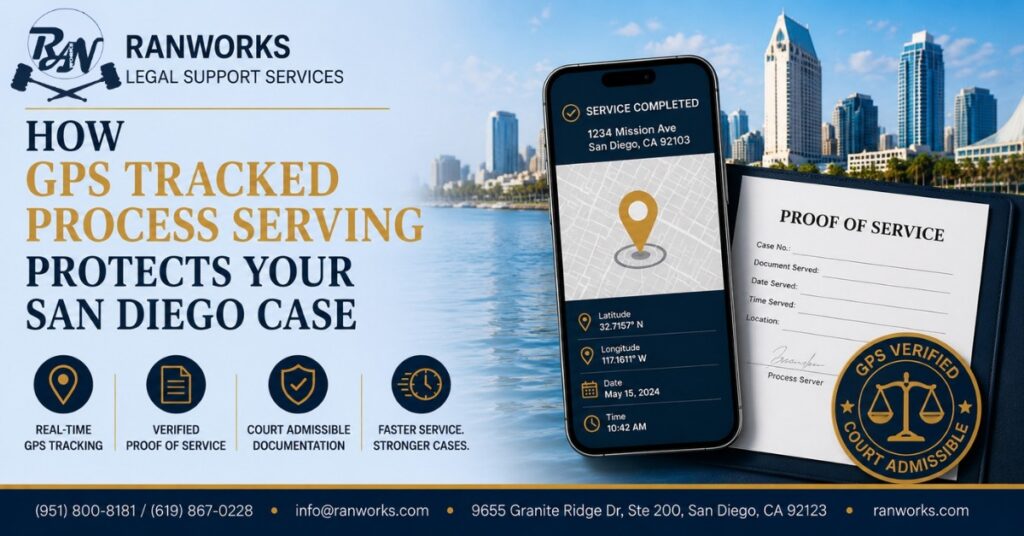
How GPS Tracked Process Serving Protects Your San Diego Case | Ranworks A signed Proof of Service used to be enough on its own. In most cases it still is. But when a defendant disputes that they were ever served, or claims the server was never at the stated address, an attorney needs more than a signature to win that argument. This is where a GPS tracked process server in San Diego makes a real difference. This guide explains what GPS tracked process serving actually involves, why it matters for your case, and what attorneys and law firms should expect from this level of documentation. What Is GPS Tracked Process Serving? GPS tracked process serving means that every attempt to deliver legal documents is logged with verified location data and a timestamp, captured at the exact moment of the attempt. Instead of relying only on a server’s written recollection, the documentation includes objective, location verified evidence. This applies whether the attempt is successful or not. Each visit to an address, whether the door opens or not, becomes part of a documented record tied to a specific place and time. Why Use a GPS Tracked Process Server in San Diego? Attorneys and law firms in San Diego increasingly ask for GPS tracked service because it directly reduces the risk of a successful challenge to service of process. Here is what GPS tracking adds to a standard Proof of Service: Verified coordinates confirming the server was physically present at the address An automatic timestamp that cannot be altered after the fact A documented history of every attempt, not just the final successful one Stronger support for substituted service when personal service repeatedly fails Reduced reliance on the server’s memory or handwritten notes weeks after the event A GPS tracked process server in San Diego is used because the location data and timestamps captured during each attempt provide objective proof of where and when service occurred. This strengthens the Proof of Service and makes it significantly harder for opposing counsel to successfully challenge service in court. GPS Tracking vs Traditional Process Serving Documentation The difference becomes clear when comparing how each approach holds up under scrutiny. Documentation Type Without GPS Tracking With GPS Tracking Location Proof Server’s written statement only Verified coordinates at time of service Timestamp Accuracy Manually recorded Automatically logged Court Challenge Risk Higher Lower Diligent Attempt Record Relies on memory and notes Time stamped attempt history Credibility in Disputes Server’s word against defendant’s Objective data supports the affidavit Attorney Confidence Variable Consistently strong Traditional documentation is not inherently invalid. Courts have accepted handwritten Proofs of Service for decades. But when a case becomes contentious, GPS verified data gives attorneys a meaningfully stronger position than a server’s recollection alone. How GPS Data Holds Up When Service Is Challenged in Court When opposing counsel files a motion to quash service, the court looks at the credibility and completeness of the Proof of Service. A defendant might claim they were never approached at that address, or that the encounter happened on a different day. With GPS tracked documentation, the server’s affidavit is supported by coordinates and a timestamp that align with the claimed time and location of service. This does not just support the server’s word, it gives the court an objective data point that is difficult to dispute without contrary evidence of its own. Important: GPS data strengthens a Proof of Service but does not replace the legal requirements for diligent attempts or proper method of service. Attorneys should still ensure the correct service method, whether personal or substituted, was used and properly documented. Why This Matters Even More for Evasive Recipients Some cases involve a recipient who is actively avoiding service. This often requires multiple attempts at different times of day, sometimes at different locations such as a home and a workplace. Each of these attempts matters if the case later requires a motion for substituted service or service by publication. GPS tracked attempts create a clear pattern showing genuine, diligent effort. Rather than a vague summary of how many times someone tried, the court sees a specific record of dates, times, and locations, which directly supports the legal standard for diligence required before alternative service methods are approved. What Attorneys and Law Firms Should Look for in GPS Documentation Not all process servers offer the same quality of GPS documentation. When evaluating a process server for law firms in San Diego, attorneys should confirm the following: Coordinates are captured automatically at the time of the attempt, not added manually afterward Timestamps are tied directly to each attempt and included in the final Proof of Service Documentation includes both successful and unsuccessful attempts The affidavit format meets California Rules of Court standards for direct filing The server can speak to the documentation if called to testify regarding service How Ranworks Delivers GPS Tracked Process Serving in San Diego Ranworks Legal Support Services has provided process serving San Diego CA attorneys and law firms rely on since 2002. Every assignment, regardless of outcome, includes GPS verified location data and a timestamp for each attempt. What this looks like in practice for our clients: Every attempt, successful or not, is logged with GPS coordinates and the exact time Proof of Service affidavits include this data formatted for direct court filing Attorneys receive status updates after each attempt without needing to follow up Documentation supports motions for substituted service when diligent attempts are required Coverage extends throughout all of San Diego County, from downtown to rural East County addresses For full details on coverage areas, turnaround times, and pricing, visit our process server San Diego service page. Need service of process backed by verified documentation your case can rely on? Visit our process server San Diego page to review coverage and pricing, or call 888-636-0293 to discuss your case with our team. Frequently Asked Questions Why use a GPS tracked process server in San Diego? A GPS tracked process server in San Diego
How GPS Tracked Process Serving Protects Your San Diego Case Read More »
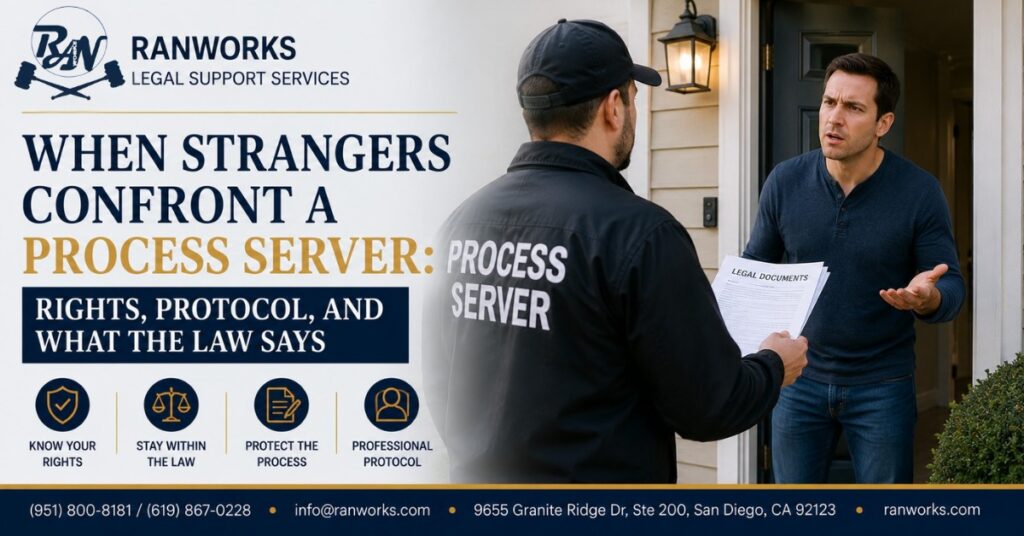
Process Servers in Gated Communities: California Law Most people who live in a gated community have no reason to think about how legal documents get delivered inside those gates. That changes the moment a lawsuit, subpoena, or restraining order names someone at that address. A recent Ranworks assignment in San Diego County shows how fast a routine attempt can shift. A server entered a gated community lawfully, found the subject not home, and while exiting was confronted by two residents with no connection to the case. They photographed her credentials, referenced being armed, and challenged her right to be there. She identified herself, disengaged, and waited outside for law enforcement. The service was not completed that day. The case record stayed clean. This is not an unusual story. Confrontations with neighbors, bystanders, and strangers happen on residential streets, at apartment complexes, and inside gated communities. For active California servers, these situations are not uncommon. This guide covers what the law says about these situations and what good protocol looks like when they arise. A Process Server’s Right to Be There California law is clear on this point. A registered process server is allowed to enter a staffed gated community to deliver legal documents. All they need to do is show valid identification and proof of their current registration. The gate guard or security personnel must provide reasonable access after the registered process server presents valid identification and proof of current registration. This is covered under California Code of Civil Procedure Section 415.21, and the full text is available on the California Legislative Information website. This right was expanded in 2020 to cover apartment buildings with three or more units and condo complexes with four or more units. The thinking behind the law is straightforward: living in a gated community does not put anyone beyond the reach of the courts. Two things have to be true for this law to apply. The server must be currently registered as a process server in California. And there must be an actual person staffing the gate at the time of the attempt. If the gate runs on an automated system with no guard present, this law does not apply, and the server has to find another way in or explore other options. When a Neighbor, Bystander, or Stranger Confronts the Server The person being served is often not the one who creates a difficult situation; it is the people around them. At a house, it might be a partner or roommate who comes to the door ready for a fight. At an apartment building, it could be a neighbor who sees what is happening and decides to get involved. At a gated community, it looks like what happened to the Ranworks server in San Diego: residents with no stake in the matter who photographed her credentials, referenced being armed, and challenged her right to be on the property. On a residential street, it might be a stranger who watched the server park, followed them to the door, and decided their presence needed explaining. Every one of these situations calls for the same response: State who you are and why you are there. If the confrontation continues, stop engaging and move away from the immediate area. Do not argue, do not try to push through, and do not stay on scene if the situation feels unsafe. Document everything before leaving the area. Contact law enforcement if threats are made. The San Diego server did exactly this. She said what needed to be said, recognized the situation was not going to resolve itself, and waited outside the gate for law enforcement rather than re-entering the property. What she did not do matters just as much. She did not raise her voice. She did not debate her right to be there beyond stating it once. She did not go back in. And before leaving, she documented everything. From a legal standpoint, none of these people, whether a neighbor, a bystander, or a stranger at the door, have any authority to stop a registered process server from completing a lawful delivery. Blocking, detaining, threatening, or physically interfering with a lawful process server may expose the individual to civil liability or, depending on the circumstances, criminal consequences. The emotional weight of what is being served, whether a divorce filing, a restraining order, or a civil judgment, sometimes spills onto the people nearby. That is a reality of the job. It is not a reason to engage. The goal in every confrontation is the same: leave the scene safely, and leave the case record clean. Why Documentation Decides the Outcome When a serve gets interrupted or contested, the notes from that day become the official record. GPS coordinates showing exactly where the server was, a timestamped log of what happened, and a written account of who was present and what was said: all of that becomes part of the file. Ranworks documents every attempt with GPS coordinates, timestamped notes, and a full written account of what the server observed. That level of detail matters directly for process serving services in California because a contested attempt with solid documentation is a very different situation from a contested attempt with a one-line note. If opposing counsel later questions whether service was handled properly, the documentation is what answers that question. GPS records are particularly useful because they verify the server’s location independently of anything the server wrote down. GPS-backed documentation can provide powerful corroborating evidence showing where and when a service attempt occurred. When the Attempt Cannot Be Completed Sometimes a gated community attempt does not work out on the first visit, or the second. When that happens, there are other options. In Bein v. Brechtel-Jochim Group, Inc. (1992), a California appellate court upheld substituted service through a gated community’s security personnel after access to the defendant was denied. The case remains an important authority when defendants use controlled-access communities to frustrate service attempts. That requires going back to court for
When Strangers Confront a Process Server: Rights, Protocol, and What the Law Says Read More »

How to Serve Legal Documents in San Diego: A Step by Step Guide for Attorneys | Ranworks Service of process is one of those tasks that looks simple on paper and becomes complicated the moment a defendant does not want to be found. For attorneys managing active caseloads in San Diego, getting service right the first time saves weeks of delay and protects the case from a procedural challenge later. This guide walks through exactly how to serve legal documents in San Diego, the rules attorneys need to follow, and where a dedicated process server for attorneys in San Diego fits into the workflow. Why Proper Service of Process Matters for Attorneys A case cannot move forward until the court is satisfied that the opposing party received proper notice. If service is done incorrectly, defective, or undocumented, opposing counsel can file a motion to quash service — which stalls the case and can damage your credibility with the court. For attorneys, this makes service of process a risk management issue, not just an administrative task. The stakes are higher in time-sensitive matters such as restraining orders, unlawful detainer actions, and cases approaching a statute of limitations deadline. How Do I Serve Legal Documents in San Diego? The Step-by-Step Process Attorneys often ask how do I serve legal documents in San Diego when managing a new filing. The process follows a consistent legal sequence under the California Code of Civil Procedure, regardless of case type. Step Action 01 File the initial documents with San Diego Superior Court and obtain the case number 02 Identify the correct party to be served and confirm their last known address 03 Select a process server for attorneys in San Diego who is registered with the county 04 Provide the server with the documents, recipient details, and any deadline constraints 05 The server attempts personal service, varying time of day if needed 06 If personal service fails after diligent attempts, substituted service may be used 07 The server documents every attempt with date, time, location, and outcome 08 A signed Proof of Service is prepared and returned to the attorney 09 The Proof of Service is filed with the court, electronically or in person To serve legal documents in San Diego, file your case with the court, confirm the recipient’s address, then hire a registered process server to attempt personal delivery. If personal service is unsuccessful after diligent attempts, substituted service may apply. The server documents each attempt and prepares a signed Proof of Service, which is then filed with the court to confirm the case can proceed. Who Can Legally Serve Documents in San Diego? In California, several parties are permitted to serve legal documents — but not all options are advisable for attorneys managing active litigation. Registered process servers, who are bonded and experienced with court requirements The county sheriff, who can serve documents for a fee but often has longer turnaround times Any adult who is not a party to the case, in limited situations Attorneys themselves and their staff generally cannot serve documents in their own case, since California law requires the server to be a neutral, non-party adult. This is one reason most law firms rely on a dedicated process server for attorneys in San Diego rather than attempting service in-house. Choosing the Right Method of Service for Your Case Not every case calls for the same approach. Attorneys should match the service method to the urgency and nature of the matter. Personal Service Best for most civil litigation, family law filings, and any case where the recipient’s address is confirmed and stable. This is the most defensible method in court. Substituted Service Used when personal service repeatedly fails. Requires documented diligent attempts before this method becomes valid. Courts expect to see a clear attempt history before accepting substituted service. Service by Publication Reserved for situations where the recipient genuinely cannot be located despite a thorough search, including skip tracing. Requires court approval and is typically the slowest method. Important for attorneys: Substituted service and service by publication both require proof of diligent effort. Working with a process server for attorneys in San Diego who documents every attempt with GPS data and timestamps gives you a stronger record if the method of service is ever challenged. Common Mistakes Attorneys Should Avoid When Serving Documents 1 Waiting Too Long to Initiate Service Statutes of limitations and court deadlines do not pause for a slow start. Initiating service as soon as the case is filed gives more room to handle an evasive defendant or address issues that arise. 2 Using an Unregistered Server If the server is not properly registered in California, the validity of service can be challenged — even if the documents were technically delivered. Always confirm registration status before assigning service. 3 Incomplete Proof of Service A Proof of Service missing required details — such as physical description, exact time, or method of service — can be rejected by the court or challenged by opposing counsel. 4 Not Documenting Failed Attempts If a case eventually requires substituted service or a motion for alternative service, the court wants to see a documented history of attempts. Skipping this step weakens your position later. 5 Overlooking Skip Tracing When the Address Is Bad If the recipient no longer lives at the known address, continuing to attempt service there wastes time. Skip tracing should be used early to confirm a current address. What to Do When Service of Process Is Challenged If opposing counsel files a motion to quash service, attorneys need a complete and credible record to respond. This includes the Proof of Service, attempt logs with timestamps, and any supporting documentation such as GPS data or photographs from the process server. A process server for attorneys in San Diego who provides GPS-tracked documentation on every attempt gives attorneys a stronger position when defending the validity of service in front of a judge. Why Law Firms Rely on a Process Server for
How to Serve Legal Documents in San Diego: A Step by Step Guide for Attorneys Read More »