June 2026

Best Nationwide Process Serving Companies: What to Look for in a National Partner

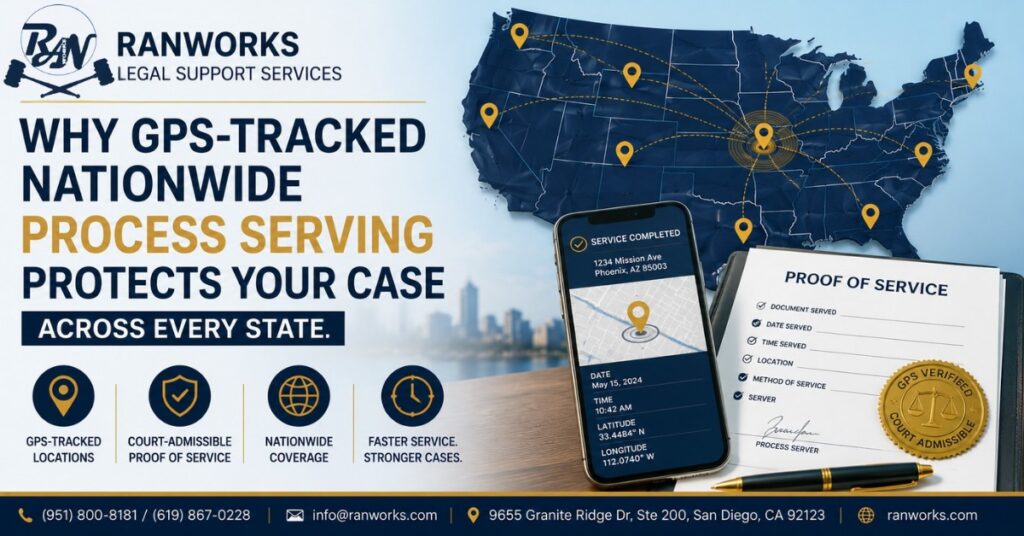
Best Nationwide Process Serving Companies | Ranworks Attorneys who handle multi-state litigation face a vendor coordination problem that goes beyond simply finding someone to hand over documents. Each state has its own service rules, its own licensing standards, and its own requirements for what a valid proof of service must contain. Choosing the wrong partner for out-of-state work creates evidentiary risk that can resurface months later when service is challenged. Choosing the right national process serving company comes down to a specific set of verifiable criteria. General promises about reach or reliability are not enough. This article walks through what that criteria actually looks like in practice, what questions to ask before committing to a vendor, and what separates the providers that protect your case from the ones that create new problems. Why Your Choice of Process Serving Partner Affects Case Outcomes A defective proof of service is not just an administrative inconvenience. Under the California Code of Civil Procedure and the Federal Rules of Civil Procedure, service that fails to meet the required standards can be quashed. That means a case that was properly filed and diligently prosecuted can be set back months because the service event itself was improperly documented or executed. The risk compounds in multi-state matters because the plaintiff’s attorney has less direct visibility into what is happening on the ground. An attorney in San Diego coordinating service of a defendant in Ohio is relying entirely on whoever is handling that assignment. If that server lacks proper local credentials, submits an incomplete affidavit, or fails to follow Ohio’s specific service rules, the attorney may not find out until opposing counsel files a motion to quash. This is why the decision about which agency to trust with out-of-state assignments deserves more scrutiny than it often receives. What a Credentialed Nationwide Process Server Actually Looks Like Licensing requirements for process servers vary significantly by state. California requires registration with the county Sheriff’s office. Other states have their own registration or bonding requirements, and some have no formal licensing system at all. The absence of a state requirement does not mean credentials are unimportant. It means the buyer must look harder. A reputable coordinating agency uses locally licensed servers in states that have licensing requirements. For states without formal requirements, it uses servers who carry professional bonds and insurance. These are not cosmetic credentials. A bonded server provides a financial backstop if something goes wrong. Insurance protects the attorney’s client from losses caused by server error or misconduct. Before engaging any agency for out-of-state work, ask specifically whether the local servers they use in each state carry individual bonds and whether those bonds are current. Reputable agencies maintain this documentation on file and can produce it without delay. If a vendor is vague about the credentials of their network servers, that is meaningful information about the level of oversight they actually exercise. California Secretary of State Business Search — verify process server registration GPS Documentation: The Standard That Professional Nationwide Process Serving Should Meet The affidavit of service is the document that a court ultimately evaluates if service is challenged. A thorough affidavit includes the date and time of each attempt, the address where service was attempted or completed, a physical description of the person served, the method of service used, and the server’s declaration under penalty of perjury. GPS-tracked documentation adds objectively verifiable location data to that record. GPS tracking matters in cross-state service assignments because it removes the possibility of a server claiming service occurred at a location they never visited. When the affidavit carries coordinates and a timestamp tied to a specific address, opposing counsel faces a much higher evidentiary threshold to successfully argue that service did not take place. Ask any agency you are evaluating whether GPS documentation is standard on all assignments or only available on premium service tiers. An agency that reserves GPS tracking for higher-priced options is telling you something about how seriously they treat documentation on standard work. Federal Rules of Civil Procedure Rule 4 — requirements for summons and service Single Point of Contact: What It Means and Why It Matters One of the most practical advantages a national process serving company offers is administrative consolidation. Managing five defendants in five different states through five separate vendors means five different billing relationships, five different communication chains, and five different documentation formats arriving at different times. None of that work moves the case forward. It just creates overhead. A single coordinating agency absorbs all of that friction. One case number, one invoice, one contact who knows the full assignment history. When a service attempt fails in one state, the coordinating agency handles the follow-up strategy without requiring the attorney to re-explain the case to a new vendor. When affidavits arrive, they come in a consistent format that requires no translation between different server styles. This operational value is easy to underestimate when evaluating vendors on credential or price alone, but attorneys who have managed complex multi-state matters tend to place significant weight on it. Ranworks manages process serving coordination across all 50 states from a single point of contact in San Diego. Visit our Nationwide Process Serving Services page for full details. Turnaround Standards and Communication Expectations Process serving timelines are rarely the first thing attorneys ask about, but they matter considerably when litigation deadlines are involved. A provider that cannot give you a reliable first-attempt window is a provider that cannot help you plan. Standard service for most out-of-state assignments completes within 5 to 10 business days for the first attempt. Rush service typically shortens that to 72 hours. Same-day or emergency service is available from some coordinating agencies for the most time-sensitive matters. Know these tiers before you need them, because figuring it out on the day of an emergency deadline is not a practical option. Communication standards matter as much as speed. An agency that confirms receipt within one business hour, sends attempt notifications after each try,

Best Nationwide Process Serving Companies: What to Look for in a National Partner Read More »

How to Serve Legal Documents in San Diego: A Step by Step Guide for Attorneys

How to Serve Legal Documents in San Diego: A Step by Step Guide for Attorneys

How to Serve Legal Documents in San Diego: A Step by Step Guide for Attorneys | Ranworks Service of process is one of those tasks that looks simple on paper and becomes complicated the moment a defendant does not want to be found. For attorneys managing active caseloads in San Diego, getting service right the first time saves weeks of delay and protects the case from a procedural challenge later. This guide walks through exactly how to serve legal documents in San Diego, the rules attorneys need to follow, and where a dedicated process server for attorneys in San Diego fits into the workflow. Why Proper Service of Process Matters for Attorneys A case cannot move forward until the court is satisfied that the opposing party received proper notice. If service is done incorrectly, defective, or undocumented, opposing counsel can file a motion to quash service — which stalls the case and can damage your credibility with the court. For attorneys, this makes service of process a risk management issue, not just an administrative task. The stakes are higher in time-sensitive matters such as restraining orders, unlawful detainer actions, and cases approaching a statute of limitations deadline. How Do I Serve Legal Documents in San Diego? The Step-by-Step Process Attorneys often ask how do I serve legal documents in San Diego when managing a new filing. The process follows a consistent legal sequence under the California Code of Civil Procedure, regardless of case type. Step Action 01 File the initial documents with San Diego Superior Court and obtain the case number 02 Identify the correct party to be served and confirm their last known address 03 Select a process server for attorneys in San Diego who is registered with the county 04 Provide the server with the documents, recipient details, and any deadline constraints 05 The server attempts personal service, varying time of day if needed 06 If personal service fails after diligent attempts, substituted service may be used 07 The server documents every attempt with date, time, location, and outcome 08 A signed Proof of Service is prepared and returned to the attorney 09 The Proof of Service is filed with the court, electronically or in person To serve legal documents in San Diego, file your case with the court, confirm the recipient’s address, then hire a registered process server to attempt personal delivery. If personal service is unsuccessful after diligent attempts, substituted service may apply. The server documents each attempt and prepares a signed Proof of Service, which is then filed with the court to confirm the case can proceed. Who Can Legally Serve Documents in San Diego? In California, several parties are permitted to serve legal documents — but not all options are advisable for attorneys managing active litigation. Registered process servers, who are bonded and experienced with court requirements The county sheriff, who can serve documents for a fee but often has longer turnaround times Any adult who is not a party to the case, in limited situations Attorneys themselves and their staff generally cannot serve documents in their own case, since California law requires the server to be a neutral, non-party adult. This is one reason most law firms rely on a dedicated process server for attorneys in San Diego rather than attempting service in-house. Choosing the Right Method of Service for Your Case Not every case calls for the same approach. Attorneys should match the service method to the urgency and nature of the matter. Personal Service Best for most civil litigation, family law filings, and any case where the recipient’s address is confirmed and stable. This is the most defensible method in court. Substituted Service Used when personal service repeatedly fails. Requires documented diligent attempts before this method becomes valid. Courts expect to see a clear attempt history before accepting substituted service. Service by Publication Reserved for situations where the recipient genuinely cannot be located despite a thorough search, including skip tracing. Requires court approval and is typically the slowest method. Important for attorneys: Substituted service and service by publication both require proof of diligent effort. Working with a process server for attorneys in San Diego who documents every attempt with GPS data and timestamps gives you a stronger record if the method of service is ever challenged. Common Mistakes Attorneys Should Avoid When Serving Documents 1 Waiting Too Long to Initiate Service Statutes of limitations and court deadlines do not pause for a slow start. Initiating service as soon as the case is filed gives more room to handle an evasive defendant or address issues that arise. 2 Using an Unregistered Server If the server is not properly registered in California, the validity of service can be challenged — even if the documents were technically delivered. Always confirm registration status before assigning service. 3 Incomplete Proof of Service A Proof of Service missing required details — such as physical description, exact time, or method of service — can be rejected by the court or challenged by opposing counsel. 4 Not Documenting Failed Attempts If a case eventually requires substituted service or a motion for alternative service, the court wants to see a documented history of attempts. Skipping this step weakens your position later. 5 Overlooking Skip Tracing When the Address Is Bad If the recipient no longer lives at the known address, continuing to attempt service there wastes time. Skip tracing should be used early to confirm a current address. What to Do When Service of Process Is Challenged If opposing counsel files a motion to quash service, attorneys need a complete and credible record to respond. This includes the Proof of Service, attempt logs with timestamps, and any supporting documentation such as GPS data or photographs from the process server. A process server for attorneys in San Diego who provides GPS-tracked documentation on every attempt gives attorneys a stronger position when defending the validity of service in front of a judge. Why Law Firms Rely on a Process Server for

How to Serve Legal Documents in San Diego: A Step by Step Guide for Attorneys Read More »

Wage Garnishment in San Diego: A Complete Guide for Creditors and Attorneys

Wage Garnishment in San Diego: A Complete Guide for Creditors and Attorneys

Wage Garnishment in San Diego: A Guide for Creditors and Attorneys | Ranworks You won your civil case in the San Diego Superior Court. The judgment is entered. The debtor owes you money. But weeks go by, and nothing arrives. No payment. No communication. No compliance. This is where wage garnishment becomes one of the most powerful tools available to creditors and their attorneys in California. When used correctly and with the right enforcement support, wage garnishment can turn a paper judgment into real, consistent payments. In this guide, Ranworks Legal Support Services walks you through exactly how the process works in San Diego, the legal sequence involved, how it compares to a bank levy, and how our team handles the field enforcement work that California attorneys depend on to turn a court order into collected funds. What Is Wage Garnishment and How Does It Work in California? Wage garnishment is a legal process that allows a judgment creditor to collect money owed by having a portion of the debtor’s wages withheld directly by their employer and paid to the creditor. In California, wage garnishment is governed by the Code of Civil Procedure Sections 706.010 through 706.154. Once a creditor obtains a judgment, they can apply for an Earnings Withholding Order (EWO), which is the California court document that directs an employer to withhold a portion of an employee’s wages and forward them to the creditor. Key facts about wage garnishment in California: A judgment must be entered before wage garnishment can begin Only one earnings withholding order can be enforced against a debtor at a time The employer is legally required to comply once properly served with the EWO Wage garnishment continues until the judgment is satisfied or the order expires A California wage garnishment order is valid for a single continuous period of employment Wage garnishment in San Diego works by obtaining a court-issued Earnings Withholding Order after securing a civil judgment. The order is served on the debtor’s employer, who must then withhold a portion of the debtor’s wages each pay period and forward the funds to the creditor until the judgment is paid in full. How Does Wage Garnishment Work for Collecting a Judgment in San Diego? Collecting on a judgment in San Diego through wage garnishment involves a specific legal sequence. Understanding this process helps creditors and attorneys manage timelines and expectations. The process begins after a judgment is entered by the San Diego Superior Court. The creditor must then locate the debtor’s current employer, which is often the most challenging step, and follow the correct procedural steps to obtain and serve an Earnings Withholding Order. Here is the complete step-by-step process: Step Action 01 Obtain a certified copy of the judgment from San Diego Superior Court 02 Apply for a Writ of Execution from the court clerk (valid for 180 days in California) 03 Locate the debtor’s current employer through skip tracing or asset investigation 04 Submit the Writ of Execution to the San Diego County Sheriff’s Department or a registered process server 05 The process server or sheriff serves the Earnings Withholding Order (EWO) on the employer 06 The employer has 10 days to begin withholding and must respond within 15 days 07 Funds are collected from the employer each pay period and forwarded to the creditor 08 Garnishment continues until the full judgment amount (plus interest and costs) is satisfied Ranworks handles Steps 3 through 6 for law firms and creditors throughout San Diego County. That includes skip tracing the debtor’s current employer, serving the EWO on the employer, and delivering GPS-tracked, court-admissible Proofs of Service for every attempt. How Much Can Be Garnished from Wages in California? California law limits how much of a debtor’s wages can be garnished. The state uses a formula to determine the maximum withholding amount, which is the lesser of: 25% of the debtor’s disposable earnings per pay period, OR The amount by which the debtor’s disposable earnings exceed 40 times the California minimum wage As of 2024, California’s minimum wage is $16.00 per hour ($17.00 for fast food workers), which means the protected floor is approximately $640 per week. This means lower-income debtors may have little or no wages subject to garnishment. Important: Certain income is completely exempt from wage garnishment in California, including Social Security benefits, disability payments, unemployment insurance, and workers’ compensation. A debtor can also claim additional exemptions by filing a Claim of Exemption with the court. Understanding these limits is critical for creditors and attorneys because it affects how long wage garnishment will take to satisfy a judgment and whether an alternative enforcement method such as a bank levy may be more effective in certain situations. What Is a Bank Levy and How Does It Differ from Wage Garnishment? While wage garnishment targets the debtor’s ongoing income, a bank levy targets funds already held in their bank account. Both are well-established collection tools, and experienced creditors often use both in combination. Feature Wage Garnishment Bank Levy Target Ongoing wages / income Existing bank account funds Served On Debtor’s employer Debtor’s bank or financial institution Speed Slower (ongoing) Faster (immediate seizure) Best For Regular income earners Debtors with bank accounts Exemptions Protected wage limits apply Some funds protected (e.g. benefits) Multiple Orders One EWO at a time Can levy multiple accounts Ranworks Service Full service Full service A skilled enforcement team will evaluate the debtor’s financial profile and recommend the right approach, or a combination of both, to recover the full judgment amount. Common Challenges in Judgment Enforcement in San Diego Even with a valid judgment in hand, collecting what you are owed in San Diego can be complicated. Here are the most common obstacles creditors and attorneys face: 1 Cannot Locate the Debtor’s Employer If the debtor has changed jobs, works under the table, or is self-employed, locating their current place of employment requires skip tracing and asset investigation. Without this information, an EWO cannot be served. 2 Debtor Has

Wage Garnishment in San Diego: A Complete Guide for Creditors and Attorneys Read More »