
Multi-state litigation creates a specific type of administrative pressure that single-state cases simply do not. When defendants, witnesses, or co-respondents are spread across California, Nevada, Texas, and New York, coordinating service of process becomes its own legal challenge, separate from whatever the underlying dispute actually involves. The proof of service filed in each jurisdiction must survive scrutiny. A defective affidavit in one state can stall or invalidate proceedings in another.
GPS-tracked nationwide process serving addresses that problem at the documentation level, which is where service disputes most often arise. This article explains how GPS tracking works in a multi-state process serving context, why it matters for court records, and what attorneys and law firms should look for when evaluating a national process serving company.
What GPS Tracking Actually Captures During Service
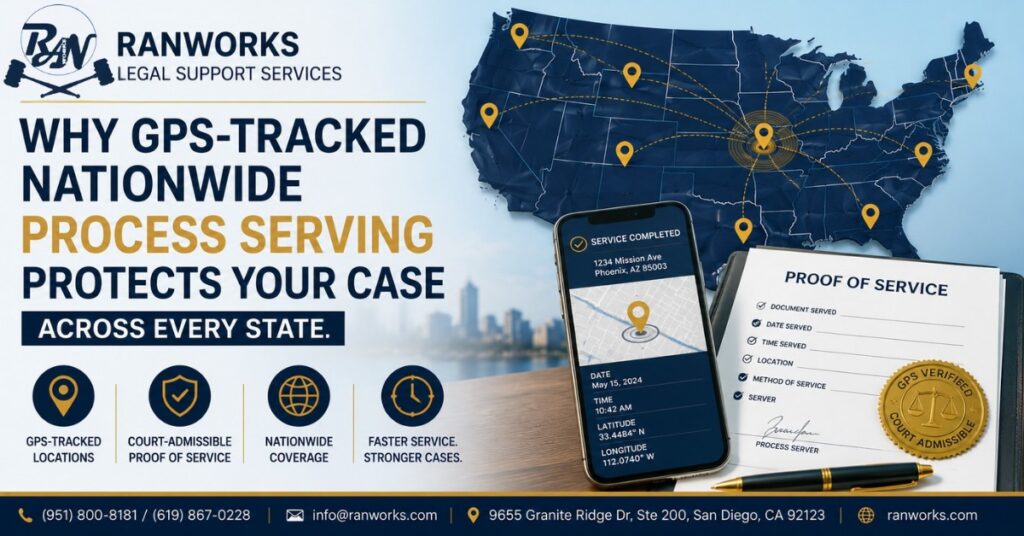
When a licensed process server uses GPS-enabled documentation, each service attempt generates a timestamped location record tied to the moment the attempt occurred. That record includes geographic coordinates, the date and time of the attempt, and, in most cases, descriptive notes about the circumstances.
The resulting affidavit of service is not simply a server’s written statement. It carries objectively verifiable location data. Courts across the country have become increasingly familiar with this form of documentation as GPS affidavits have appeared in contested service cases since the mid-2010s. The Federal Rules of Civil Procedure require that proof of service specify the method used and the details of the service event. A GPS-backed record satisfies that standard in a way that a handwritten note cannot.
For an attorney handling a case with parties in multiple states, this matters practically. Opposing counsel challenging service in Nevada does not have the same footing when a GPS-verified affidavit showing the server’s exact location at the moment of service exists in the record.
How Multi-State Service Creates Documentation Gaps
Serving documents across state lines introduces a coordination layer that exposes several documentation vulnerabilities. Each state has its own service rules. California’s Code of Civil Procedure governs how and when service must occur for California-originated matters, but if a defendant is located in Texas, Texas state rules apply to the service event itself. Federal courts add another layer, since Federal Rule of Civil Procedure 4 specifies its own requirements for summons and service.
When law firms coordinate nationwide service through multiple independent process servers, each vendor operates under their own documentation practices. The result is a collection of affidavits with inconsistent detail levels. One server produces a thorough GPS record. Another submits a two-line declaration. The case file becomes uneven, and that unevenness creates openings for service challenges.
Professional nationwide process serving through a single coordinating agency resolves this. Standards for documentation, GPS tracking requirements, and affidavit format are applied uniformly across all assignments regardless of which state the service occurs in. The attorney receives a consistent record for every party served, whether that service happened in San Diego or in Atlanta.
Ranworks coordinates out-of-state process serving across all 50 states from a single point of contact. Visit our nationwide process serving page for full details.
State-Specific Rules and the Role of Local Licensed Servers
No two states handle service of process identically. Some states permit personal service only. Others allow substituted service under defined conditions. A few jurisdictions have specific requirements about the time window for service relative to a court date. GPS documentation does not override these state rules; it supplements compliance with them.
The practical solution is a national process serving company that works with licensed local servers in each state. A California-based process server traveling to Illinois to attempt service is not the same thing as a licensed Illinois server who understands the local court requirements and knows which methods produce court-acceptable proof in that jurisdiction. GPS tracking combined with local licensure produces documentation that holds up at both the state and federal level.
This is worth examining when evaluating any national process serving arrangement. GPS tracking without local licensure is incomplete. Local licensure without standardized GPS documentation creates the consistency problem described above. Both elements together are what produces court-ready records in a multi-state case.
When GPS Documentation Becomes Critical in Contested Service
Service disputes come up more often in multi-state litigation than in routine local matters, partly because defendants in distant jurisdictions sometimes claim they were never served, and partly because monitoring service from across the country is harder for the plaintiff’s attorney.
GPS-tracked records shift that dynamic. When a defendant in another state contests service, the process server’s declaration is backed by location coordinates showing the server’s physical presence at the address at a specific time. That evidence makes a bare denial of service considerably harder to sustain.
California courts are familiar with GPS documentation from Ranworks’ California-based services, where GPS affidavits are standard practice. The same documentation approach applied through a national network means attorneys who work with Ranworks on nationwide assignments receive the same evidentiary quality across state lines as they do on local California assignments.
A GPS-enabled device carried by the process server records the precise geographic coordinates, date, and time of each service attempt. That data is embedded in the affidavit of service, creating an objectively verifiable record of the server’s physical presence at the address at a specific time. The same GPS documentation standard applies across all states when working with a national process serving company that requires it uniformly.
What to Look for in a National Process Serving Company
Attorneys evaluating nationwide process serving providers should focus on a few concrete criteria rather than general claims about reach or reliability.
GPS Documentation as Standard, Not an Add-On
Ask whether GPS documentation is standard on all assignments or only available as an add-on. A professional nationwide process serving operation should apply consistent documentation standards to every attempt, not reserve GPS tracking for premium tiers.
Locally Licensed Servers in Each State
Confirm that local licensed servers are used in each state. Ask specifically whether the company uses servers licensed in states that require licensing, and whether those servers carry bonds and insurance. Proof of licensure and bonding protects attorneys whose cases depend on the validity of service.
A Complete, Court-Ready Affidavit Format
Look at the affidavit format. A court-ready affidavit should include the server’s identity, the date and time of service, the method used, the recipient’s description, and the GPS location data. If a vendor cannot show you a sample affidavit that contains all of those elements, that is useful information.
Single Point of Contact for Multi-State Assignments
Consider whether the company operates as a single point of contact for multi-state assignments. Coordinating service in six states through six separate vendors creates billing complexity, inconsistent documentation, and communication overhead that a national process serving company handles internally.
How Ranworks Handles GPS-Tracked Nationwide Process Serving
Ranworks provides nationwide process serving coordination from its San Diego headquarters, working with licensed local servers across all 50 states. Every assignment includes GPS-tracked documentation as a standard part of the service, not an optional upgrade.
The affidavit delivered to attorneys includes exact GPS coordinates for each service attempt, timestamped records, physical description of the person served, and the server’s declaration under penalty of perjury. For attorneys managing multi-state litigation, this produces a consistent record across all jurisdictions rather than a patchwork of varying documentation formats.
For cases where the defendant’s location is unknown, Ranworks also provides skip tracing services that work nationwide, identifying current addresses before service is attempted. Once a location is confirmed, service coordination happens without a gap between the skip trace result and the actual service attempt.
What attorneys receive on every Ranworks nationwide assignment:
- Exact GPS coordinates for each service attempt, successful or not
- Timestamped records tied to each attempt and included in the affidavit
- Physical description of the person served and the method used
- Server’s declaration under penalty of perjury meeting state and federal standards
- Consistent affidavit format across all jurisdictions, not a patchwork of vendor styles
- Skip tracing available nationwide when the defendant’s location is unknown
Frequently Asked Questions
A GPS-enabled device carried by the process server records the precise geographic coordinates, date, and time of each service attempt. That data is embedded in the affidavit of service, creating an objectively verifiable record of the server’s physical presence at the address. The same GPS documentation standard applies across all states when working with a national process serving company that requires it uniformly.
GPS documentation is not mandated by most state rules, but it is generally accepted as additional evidence supporting the server’s declaration. Courts in California, federal courts, and courts in most other states accept GPS-backed affidavits as credible proof of service. The core requirement in every jurisdiction is a sworn declaration by the server, and GPS data strengthens that declaration against challenge.
A national process serving company coordinates service across multiple states from a single point of contact, using licensed local servers in each jurisdiction. A local process server handles only their own geographic area. For multi-state litigation, a national company removes the burden of finding and vetting separate servers in each state, standardizes documentation, and consolidates billing.
A California-licensed process server cannot practice in another state under their California registration. For valid service in another state, the server must meet that state’s requirements, which may include local licensure, bonding, or specific procedural compliance. Professional nationwide process serving solves this by engaging locally licensed servers in each state rather than sending California-based servers across state lines.
Most out-of-state service assignments complete within 5 to 10 business days for the first attempt. Timelines vary by state, city, and the accessibility of the person being served. Rush service is available through Ranworks for time-sensitive matters. Rural areas or states with specific procedural requirements may require additional time. Estimated timelines are provided when a quote is requested.
GPS Documentation Is What Protects Multi-State Cases
GPS-tracked nationwide process serving matters most in the situations where service is most likely to be challenged: multi-state litigation, evasive defendants, and cases where the opposing party has strong motivation to dispute service validity. A professional nationwide process serving arrangement that combines GPS documentation with locally licensed servers in each state produces the kind of court-ready record that holds up regardless of which jurisdiction reviews it.
For law firms managing cases across state lines, the value is not only evidentiary. Consolidating multi-state service through a single national process serving company reduces coordination overhead, produces consistent documentation across all jurisdictions, and keeps the attorney focused on the substance of the case rather than the logistics of serving it.
Ranworks handles GPS-tracked nationwide process serving for law firms and attorneys across all 50 states. To request service or get a quote, call 888-636-0293 or email documents@ranworks.com.
Need GPS-Tracked Process Serving Across State Lines?
Ranworks coordinates licensed, GPS-documented service in all 50 states from a single point of contact in San Diego.
View Nationwide Services Call 888-636-0293
Great content! Keep up the good work!