
How San Diego Law Firms Can Partner with a Process Serving Company for Bulk Case Management
See how San Diego law firms partner with one process serving company for bulk case management, consistent GPS documentation, and one invoice.

See how San Diego law firms partner with one process serving company for bulk case management, consistent GPS documentation, and one invoice.
One of the most common frustrations in civil litigation is when service of process stalls because a recipient cannot be found or is clearly avoiding service. It happens regularly in divorce cases, debt collection matters, restraining order filings, and civil disputes of all kinds. The good news is that process serving San Diego CA attorneys and individuals depend on does not simply stop when the first attempt fails. California law provides a structured series of options that give creditors, attorneys, and petitioners a clear path forward even when a recipient is evasive or missing. Ranworks Legal Support Services has handled thousands of difficult service assignments throughout San Diego County over 23 years. This guide walks through exactly what happens at each stage when standard service cannot be completed. The Short Answer: Failed Service Does Not Mean Your Case Is Over If a process server cannot serve someone in San Diego, California law provides several options depending on the situation. The server makes additional attempts at different times, uses skip tracing to locate a current address if needed, and may proceed with substituted service after diligent attempts are documented. If all standard methods fail, the court can approve alternative service methods including service by publication. A failed first attempt does not stop a case from moving forward. Step 1: Additional Attempts at Different Times A single failed attempt is rarely the end of the process. A professional process server in San Diego will vary the day and time of each attempt to account for work schedules, routines, and travel patterns. Best practice for process serving in San Diego CA assignments includes attempts at different times such as early morning before work, midday, early evening, and weekends. This approach maximizes the chance of catching the recipient at home or at a regular location. Each attempt is logged with a GPS verified timestamp so there is a documented record of diligence if the case later requires an alternative service method. Step 2: Skip Tracing to Find a Current Address If the recipient is no longer at the known address, has moved without notice, or the address on file turns out to be incorrect, the next step is skip tracing. Skip tracing is a professional investigative process that searches available records to locate a current address, workplace, or other confirmed location for the recipient. Common reasons skip tracing becomes necessary in San Diego cases include: The recipient moved after the case was filed The address on file was always incorrect The recipient is staying at a secondary location to avoid service The recipient’s employer has changed Ranworks provides skip tracing services alongside process serving in San Diego CA assignments, so clients do not need to coordinate separately with a different provider. Once a verified address is confirmed, service attempts resume immediately. Step 3: Substituted Service Under California Law If personal service cannot be completed after diligent attempts at both home and workplace addresses, California Code of Civil Procedure Section 415.20 allows for substituted service. This means leaving the documents with a responsible adult at the recipient’s home or workplace, followed by mailing a copy to the same address. Courts expect to see documented evidence of diligent attempts before substituted service is accepted. This is why GPS tracked attempt logs are critical. Without a clear record of attempts, opposing counsel can challenge the validity of substituted service. Important: Substituted service requires proof of diligent effort before it is valid. The court will look at how many attempts were made, at what times, and at which addresses. Ranworks provides complete GPS verified attempt logs that satisfy this standard. Step 4: Emergency Process Server in San Diego for Urgent Deadlines Some situations do not allow for the standard timeline of multiple attempts spread across several days. If your case involves an upcoming hearing, a restraining order that needs to be served before a court date, or any other time-sensitive deadline, an emergency process server in San Diego can be dispatched for same-day or 24 hour service. A 24 hour process server in San Diego from Ranworks operates on an expedited basis, prioritizing urgent assignments above standard queue. Same-day emergency service is available for the most time-critical matters. When to request emergency service: If your hearing is within 72 hours, if a restraining order must be served before it takes effect, or if a statute of limitations is about to run out and service has not yet been completed, contact Ranworks immediately at 888-636-0293 for emergency dispatch. Step 5: Motion for Alternative Service Approved by the Court If all standard methods, including multiple personal service attempts, skip tracing, and substituted service attempts, have failed and been properly documented, an attorney can file a motion with the court requesting permission to use an alternative method of service. The court reviews the documented history of attempts and, if satisfied that diligent effort has been made, may approve an alternative such as service by email, social media, or posting. This requires a formal court order and cannot be done without judicial approval. The strength of this motion depends heavily on the quality and completeness of the attempt documentation. A process server near me in San Diego who provides GPS verified logs with timestamps for every attempt gives attorneys the strongest possible foundation for this motion. Step 6: Service by Publication as a Last Resort Service by publication is the option of final resort when a recipient genuinely cannot be located despite thorough and documented efforts. Under California Code of Civil Procedure Section 415.50, a court may authorize service by publishing a notice in a newspaper of general circulation in the area where the defendant was last known to reside. This method is rarely used because it requires court approval, takes time, and involves publication costs. Courts also require strong evidence that all other options were genuinely exhausted before granting this authorization. It is most commonly seen in dissolution of marriage cases where a spouse has completely disappeared. Why Documented Attempt
What Happens If a Process Server Cannot Serve Someone in San Diego? Read More »
When a deadline is approaching fast, the difference between same day and 24 hour process serving in San Diego is not just a matter of speed. It affects cost, logistics, and whether your case can proceed on the timeline you need. If you are searching for a process server near me in San Diego because something urgent has come up, this guide breaks down both options clearly so you can make the right call quickly without guessing. Ranworks Legal Support Services has provided same day and 24 hour process serving across San Diego County for over 23 years. Here is exactly how both options work and when each one is the right fit. The Quick Answer: Same Day vs 24 Hour Process Serving A same day process server in San Diego is dispatched immediately and completes service within the same business day, used for the most urgent situations like hearings tomorrow or restraining orders that must be served today. A 24 hour process server in San Diego completes service within approximately one full day, suited for urgent filings where same-day dispatch is not strictly necessary but standard turnaround is too slow. Both options include GPS tracked documentation and court ready Proof of Service affidavits. What Is a Same Day Process Server in San Diego? A same day process server in San Diego is dispatched as soon as the assignment is received and prioritized above all other cases in queue. The goal is to complete at least one service attempt, and ideally successful service, before the end of the same business day. Same day service is the option most people mean when they search for an emergency process server in San Diego. It is reserved for situations where the urgency is real and any delay, even by one day, could have consequences for the case. What same day process serving in San Diego includes: Immediate dispatch upon receipt of the assignment and documents Priority status above all standard and rush queue assignments GPS tracked documentation on the attempt with an exact timestamp Real-time status update to the attorney or client after the attempt Court ready Proof of Service affidavit prepared for same-day or next-morning filing Important: Same day service requires that documents and recipient information are submitted to Ranworks as early in the business day as possible. Assignments received late in the afternoon may not allow enough time for same-day completion depending on the recipient’s location within San Diego County. What Is a 24 Hour Process Server in San Diego? A 24 hour process server in San Diego operates on an expedited basis with a target of completing service within approximately one full day of receiving the assignment. This option sits between same-day urgency and the standard 3 to 5 business day turnaround. For most urgent but not immediately critical situations, a 24 hour process server in San Diego is the most practical and cost-effective choice. It provides meaningful speed without the premium cost of same-day emergency dispatch. What 24 hour process serving in San Diego includes: High-priority assignment status processed ahead of standard queue Attempt made within the following business day of assignment receipt GPS tracked documentation on all attempts Court compliant Proof of Service with timestamps and location data Status update after each attempt Same Day vs 24 Hour vs Standard: Full Comparison Here is a direct side-by-side comparison of all three service tiers available from Ranworks for process serving San Diego CA clients: Feature Same Day Service 24 Hour Service Standard Service Turnaround Within same business day Within approximately 24 hours 3 to 5 business days Best For Restraining orders, imminent hearings Urgent filings with next-day deadline Routine civil litigation Dispatch Priority Immediate High priority same day queue Scheduled rotation Relative Cost Highest tier Mid-level add-on fee Base rate GPS Documentation Included Included Included Proof of Service Court ready affidavit Court ready affidavit Court ready affidavit Available at Ranworks Yes Yes Yes When to Choose a Same Day Process Server in San Diego Same day process serving is the right call in any of these situations: 1 Hearing Scheduled for Tomorrow Morning If a court hearing is set for the following morning and the opposing party has not yet been served, same day service is the only option that can realistically complete service in time. Courts require proof of service before a hearing can proceed in most cases. 2 Restraining Order That Must Be Served Immediately Temporary restraining orders often come with a specific timeframe in which service must be completed before the order takes effect or before the hearing on the permanent order. Same day emergency process server San Diego dispatch is the standard approach for these assignments. 3 Statute of Limitations Expiring Within 24 Hours If a deadline is within hours and service has not been completed, same day process serving is the only viable option. Acting early in the day gives the server the best chance of completing service before the window closes. 4 Last Minute Subpoena for a Deposition Starting Tomorrow Deposition subpoenas sometimes need to be served at the last possible moment due to scheduling changes or late decisions. Same day service covers this situation when the deposition date leaves no room for standard turnaround. When a 24 Hour Process Server in San Diego Is the Better Choice A 24 hour process server in San Diego is the smarter choice when urgency is real but true same-day completion is not strictly required. This option saves money while still moving significantly faster than standard service. 1 Hearing in 48 Hours With Documents Ready Now If a hearing is two days away and documents are ready to be assigned today, 24 hour service provides a comfortable completion window without the premium cost of same-day emergency dispatch. 2 Urgent Filing With a Next Business Day Deadline When a next-day deadline exists but the matter is not a true emergency, 24 hour service keeps the case on track at a more affordable rate than same-day. 3
Same Day vs 24 Hour Process Serving in San Diego: Which One Do You Need? Read More »

A statute of limitations closing by end of day. A hearing set for tomorrow morning. A restraining order that has to reach the clerk’s window before 4:30 PM. These are the moments when same day court filing in San Diego stops being a convenience and becomes a necessity. This guide explains exactly what same day court filing in San Diego is, how the process works step by step, which situations call for it, and what to look for in a rush court filing service in San Diego attorneys can rely on when the deadline is real and the margin for error is zero. Ranworks Legal Support Services has provided court filing services San Diego attorneys and law firms depend on since 2002, handling same day e-filing and same day physical delivery to all divisions of San Diego Superior Court and its branch locations. What Is Same Day Court Filing in San Diego? Same day court filing in San Diego means submitting legal documents to the court and receiving confirmation of acceptance within the same business day the request is made. This applies to both electronic filing and physical delivery to the courthouse clerk. It is not simply a faster version of standard court document filing. Same day filing requires immediate prioritization of the assignment, direct coordination with the court’s filing windows or e-filing portal, and confirmation returned to the client before the court closes for the day. Same day court filing in San Diego is the process of submitting legal documents to San Diego Superior Court and receiving confirmation of filing acceptance on the same business day. It is available via e-filing, which completes within 2 to 4 hours, or physical delivery to the courthouse when submitted before the daily cutoff time of 2 PM for San Diego County. It is used when statutes of limitations, hearing deadlines, or restraining orders require documents to be on the court’s record by end of business that day. How Does Same Day Court Filing Work in San Diego? Same day court filing in San Diego works through two distinct channels depending on what the court requires for your specific document type: Same Day E-Filing Electronic filing through an approved court portal is the fastest method. Documents are submitted digitally, processed by the court, and a transaction confirmation with the official filing timestamp is returned typically within 2 to 4 hours during court business hours. The submission timestamp is the legally significant time for deadline purposes, not the court’s processing time. Same Day Physical Delivery When e-filing is not available for a specific document type, when originals are required, or when the document requires clerk review before acceptance, physical delivery to the courthouse is the alternative. A courier or process server hand delivers the documents to the clerk’s window, waits for file stamping, and returns filed-stamped copies to the client. For San Diego County, same day physical delivery requires the assignment to be submitted to Ranworks before 2 PM. Documents received after this cutoff may not be processed until the following business day. Step by Step: How to Request Same Day Court Filing in San Diego Confirm your deadline and identify whether e-filing or physical delivery is needed for your document type and court division. Prepare your documents in the correct format. For e-filing, documents must be text-searchable PDF files. For physical delivery, originals or certified copies as required by the court should be ready. Email your documents to documents@ranworks.com with the case number, court division, document type, and the specific deadline you are working against. Ranworks confirms receipt and assigns the filing as a rush priority immediately upon intake. For e-filings, Ranworks submits through the approved e-filing portal, pays filing fees on your behalf, and monitors the submission through court acceptance. For physical delivery, a courier is dispatched to the appropriate San Diego Superior Court location before the clerk’s filing window closes. You receive the court-issued eFiling receipt and transaction confirmation for e-filings, or the filed-stamped copy with photo documentation for physical delivery, as soon as the court accepts the submission. When Do You Need Same Day Court Filing in San Diego? Most routine litigation does not require same day filing. The situations that do require it share one thing in common: a specific legal consequence that occurs if documents do not reach the court’s record by end of business that day. 1 Statute of Limitations Deadline A statute of limitations is a hard cutoff. Once it passes, the right to file that claim is permanently extinguished. If a complaint must be on file before the statute runs, same day court filing in San Diego is the only option that guarantees the deadline is met with a timestamped filing confirmation. 2 Hearing Scheduled for Tomorrow Many California courts require proof of service and related documents to be on file a certain number of days before a hearing. If a filing deadline for an upcoming hearing falls today, same day filing is required to keep the matter on calendar. 3 Restraining Order or Injunction Temporary restraining orders and emergency injunctions often need to be filed and issued the same day to take effect before a specific event. Same day court filing in San Diego makes it possible for the court to issue the order within the necessary timeframe. 4 Opposing Counsel Filed a Motion This Morning When opposing counsel files a last-minute motion that requires a same-day response or an emergency opposition, attorneys often need to prepare and file their own documents within hours. Rush court filing service in San Diego support from Ranworks handles the filing logistics while the attorney focuses on the substance of the response. 5 Default Judgment Deadline In unlawful detainer and other time-sensitive matters, missing the window to request a default can reset the case timeline significantly. Same day filing protects against this kind of procedural loss. Same Day E-Filing vs Same Day Physical Delivery in San Diego Factor Same Day E-Filing Same Day Physical Delivery Speed 2
Same Day Court Filing in San Diego: What It Is, How It Works, and When to Use It Read More »
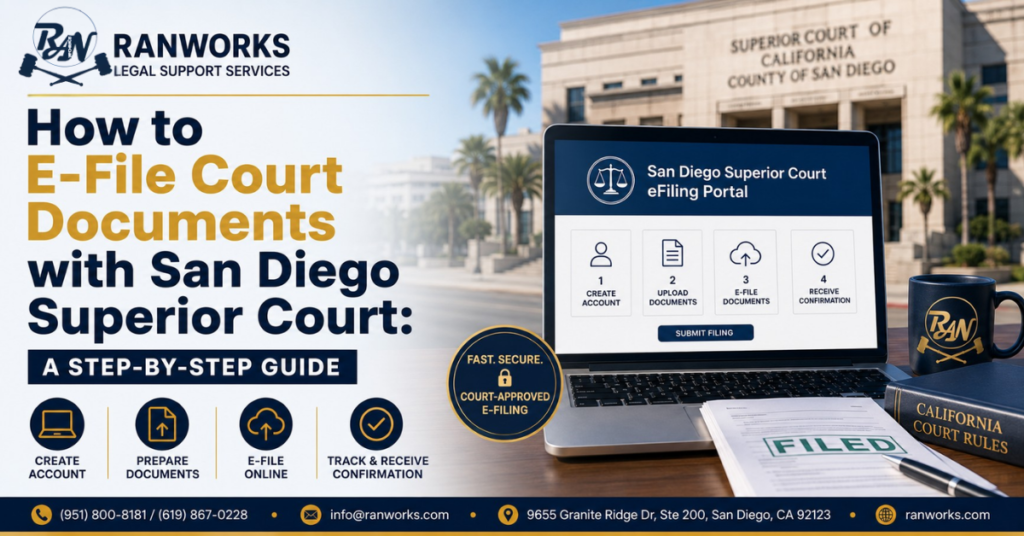
Electronic filing has become the standard method for submitting court documents at San Diego Superior Court, and for good reason. When done correctly, it is faster, more reliable, and easier to track than physical delivery. But the process has specific requirements, and a rejected filing can cost you time and create compliance problems for an active case. This guide walks through exactly how e-filing works at San Diego Superior Court, what to prepare, what to avoid, and how an experienced court e-filing service in San Diego can manage the entire process on your behalf. Ranworks Legal Support Services has provided court document filing in San Diego attorneys depend on since 2002, handling e-filing, physical delivery, and same-day filing across all divisions of San Diego Superior Court and its branch locations. What Is E-Filing at San Diego Superior Court? E-filing, or electronic filing, is the process of submitting court documents through an approved online portal rather than delivering physical copies to the courthouse in person. San Diego Superior Court requires attorneys and filers to use a court-approved Electronic Filing Service Provider (EFSP) to submit documents electronically. The court does not accept direct uploads from individual computers. All e-filings must go through an approved EFSP that converts, checks, and transmits documents to the court’s case management system. The EFSP then returns a court-issued transaction confirmation and eFiling receipt to the filer once the court processes the submission. To e-file court documents with San Diego Superior Court, prepare your documents in PDF format, select a court-approved Electronic Filing Service Provider, create an account, upload your documents, pay the filing fee, and submit. The court processes most e-filings within 2 to 4 hours during business hours and returns an eFiling receipt with a transaction confirmation number upon acceptance. Which Case Types Can Be E-Filed at San Diego Superior Court? E-filing is available for most civil case types at San Diego Superior Court. Here is a quick reference: Case Type E-Filing Available Notes Civil (unlimited and limited) Yes Most civil matters accepted via e-filing portal Family Law Yes Including dissolution, custody, support filings Probate Yes Petitions, inventories, accountings Unlawful Detainer Yes Eviction filings handled electronically Small Claims Yes Plaintiffs and defendants can e-file Post-Judgment Matters Yes Wage garnishment, bank levy, and enforcement docs Criminal No (generally) Criminal filings typically require in-person submission If you are unsure whether your specific document type can be e-filed, the Ranworks court filing services San Diego team can confirm availability before submission to avoid wasted time or a rejected filing. Step by Step: How to E-File Court Documents at San Diego Superior Court Here is the complete process for e-filing at San Diego Superior Court, from document preparation through confirmation: Prepare your documents in PDF format. San Diego Superior Court requires text-searchable PDFs. Scanned images converted to PDF without OCR processing are frequently rejected. Each document should be a separate PDF file unless the court requires them combined. Confirm you are using a court-approved EFSP. San Diego Superior Court maintains a list of approved Electronic Filing Service Providers on its website. Only filings submitted through approved providers are accepted by the court’s system. Create an account with your selected EFSP if you do not already have one. You will need to provide basic contact and billing information. Some providers charge a registration fee; others do not. Enter the case information accurately. This includes the case number, case title, court division, and document type. Errors in case information are one of the most common causes of rejection. Upload your PDF documents through the EFSP portal. Confirm that each document is correctly labeled by type, such as summons, complaint, motion, or proof of service. Review the filing fee. Court fees vary by case type, document type, and relief requested. The EFSP should display the applicable fee before you confirm submission. Pay the filing fee through the EFSP. Most providers accept major credit cards and law firm accounts. Ranworks pays filing fees on your behalf and includes the total in the invoice returned to your office. Submit the filing and note the submission timestamp. The time of submission is legally significant for deadline purposes, not the time the court processes the filing. Wait for the court-issued eFiling receipt. San Diego Superior Court typically processes e-filings within 2 to 4 hours during court business hours. The receipt includes the court’s transaction ID and confirmation of acceptance. Retain the eFiling receipt and transaction confirmation for your records. Ranworks returns all filing receipts, transaction IDs, and rejection notices to the attorney or client immediately upon receipt from the court. Common E-Filing Rejections and How to Avoid Them Rejections delay your case and can create compliance problems if a deadline passes while the filing is being corrected. Here are the most common reasons San Diego Superior Court rejects e-filings and how to prevent each one: 1 Non-Searchable PDF The court requires text-searchable PDFs. A scanned document saved as a PDF without optical character recognition applied will be rejected. Always use a PDF creator that produces searchable text, or run OCR processing before uploading. 2 Incorrect Case Number or Division Case numbers must match the court’s records exactly. A transposed digit or an incorrect division code causes an immediate rejection. Double-check the case number from the court’s online case management system before submitting. 3 Missing or Incorrect Filing Fee Submitting without the correct filing fee, or submitting without any fee when one is required, results in rejection. Confirm the applicable fee for your specific document type before submission, since fees vary by case type and document category. 4 Wrong Document Format or Combination Some document types must be submitted separately. Combining documents that the court requires as individual files, or splitting documents that the court requires combined, causes processing errors. Confirm document requirements for your case type before uploading. 5 Filing Outside Court Hours E-filings submitted outside court business hours are timestamped for the submission time but may not be processed until the next business day. This
How to E-File Court Documents with San Diego Superior Court: A Step by Step Guide Read More »
Process serving is one of those services most people know they need but have no idea what it costs until they start searching. If you are looking for a process server in San Diego, whether for a one-time filing or regular legal support for your practice, this guide gives you a clear, honest breakdown of what to expect to pay and why. Ranworks Legal Support Services has provided process serving San Diego CA clients depend on since 2002. This guide is written from real experience handling tens of thousands of assignments across San Diego County, with the goal of giving you the most useful and transparent pricing overview available. What Does a Process Server Cost in San Diego? A process server in San Diego typically charges between $75 and $125 for standard service, depending on the location within the county. Rural, remote, or higher-travel areas cost more than metro San Diego addresses. Faster turnaround options, including rush, expedited, and same-day service, carry additional fees on top of the base rate. A process server in San Diego costs roughly $75 to $125 for standard service, depending on the address location within the county. Rush service adds approximately $50, expedited service adds around $125, and same-day emergency service is quoted on a case-by-case basis. Additional fees apply for skip tracing when a recipient needs to be located first. What Affects the Cost of Process Serving in San Diego? Not every assignment in San Diego costs the same. Here are the main variables that determine what you will pay: 1 Location Within San Diego County San Diego County covers over 4,200 square miles, from downtown San Diego to rural East County communities like Alpine, Jamul, and Pine Valley. Metro addresses close to central San Diego are typically priced at the lower end. Addresses in North County, South County, or the far East County areas, which require more travel time, are priced higher. 2 Turnaround Speed Standard service costs less than rush, expedited, or same-day service. The faster the turnaround required, the more priority resources are needed to complete the assignment, which is reflected in the fee. 3 Number of Parties and Addresses Process serving is priced per party, per address, per document. A case with one defendant at one address costs less than a case with three defendants at different locations across the county. 4 Whether Skip Tracing Is Required If the recipient’s address is unknown, outdated, or the person appears to be avoiding service, skip tracing is required before service can be attempted. This is a separate service billed in addition to the process serving fee. 5 Number of Attempts Needed Most pricing covers an agreed number of attempts. If service requires an unusually high number of attempts due to an evasive recipient, additional attempt fees may apply beyond what is included in the base rate. Standard, Rush, Expedited, and Same Day Process Server Pricing in San Diego Here is how the main service tiers at Ranworks break down in terms of turnaround and cost structure: Service Type Typical Turnaround What It Covers Standard Service 3 to 5 business days First attempt at stated address, GPS documented Proof of Service Rush Service Within 72 hours Priority dispatch with same GPS documentation, add-on fee applies Expedited Service Within 24 hours Faster dispatch for time-sensitive filings, higher add-on fee applies Same Day / Emergency Same business day Immediate dispatch for restraining orders, urgent hearings Skip Tracing Add-On 24 to 48 hours Locating current address when recipient has moved or is unavailable Rush service adds $50 to the base rate. Expedited service adds $125. Same-day emergency service is quoted directly based on the specific situation. These fees apply per party, per address. What Is Included in the Base Rate? When you hire an affordable process server in San Diego from Ranworks, the base rate includes: Multiple attempts at different times of day at the stated address GPS tracked documentation on every attempt, successful or not A court compliant Proof of Service affidavit with location coordinates, timestamps, and a signed declaration under penalty of perjury Status updates after each attempt so you know exactly what is happening E-filing support available once service is complete There are no hidden fees for GPS tracking or documentation. These are standard with every assignment, not add-ons. What Costs Extra Beyond the Base Rate? Certain situations require additional services beyond standard process serving. Here is what typically carries an added cost: Rush service: $50 added to the base rate for 72-hour turnaround Expedited service: $125 added to the base rate for 24-hour turnaround Same-day emergency service: quoted individually based on the specifics Skip tracing: priced separately when a current address needs to be located Addresses outside standard San Diego County coverage: priced based on location Note: Always ask for a written quote before any assignment begins. A reputable affordable process server San Diego provider confirms all fees upfront and in writing so there are no surprises once the work is underway. Affordable vs Cheap: How to Compare Process Servers on Value Searching for a process server near me in San Diego often returns a mix of providers at very different price points. The lowest-priced option is not always the most cost-effective choice when you factor in the risk of defective service. Here is a quick reference for evaluating value when comparing providers: What to Check Red Flag Green Flag Registration Cannot confirm county registration Provides registration number on request Bond Vague or unable to confirm Bonded and confirms it in writing Documentation Basic handwritten affidavit only GPS tracked, time stamped Proof of Service Pricing Clarity Quote changes after work starts Written quote confirmed before starting Communication Hard to reach after assignment begins Status updates after every attempt Experience Newly started, no local track record 23+ years serving San Diego County A Proof of Service that gets challenged in court because of poor documentation can delay your case and require service to be repeated, which costs far more than the difference
How Much Does a Process Server Cost in San Diego? Pricing Explained Read More »
GPS-Tracked Nationwide Process Serving | Ranworks Multi-state litigation creates a specific type of administrative pressure that single-state cases simply do not. When defendants, witnesses, or co-respondents are spread across California, Nevada, Texas, and New York, coordinating service of process becomes its own legal challenge, separate from whatever the underlying dispute actually involves. The proof of service filed in each jurisdiction must survive scrutiny. A defective affidavit in one state can stall or invalidate proceedings in another. GPS-tracked nationwide process serving addresses that problem at the documentation level, which is where service disputes most often arise. This article explains how GPS tracking works in a multi-state process serving context, why it matters for court records, and what attorneys and law firms should look for when evaluating a national process serving company. What GPS Tracking Actually Captures During Service When a licensed process server uses GPS-enabled documentation, each service attempt generates a timestamped location record tied to the moment the attempt occurred. That record includes geographic coordinates, the date and time of the attempt, and, in most cases, descriptive notes about the circumstances. The resulting affidavit of service is not simply a server’s written statement. It carries objectively verifiable location data. Courts across the country have become increasingly familiar with this form of documentation as GPS affidavits have appeared in contested service cases since the mid-2010s. The Federal Rules of Civil Procedure require that proof of service specify the method used and the details of the service event. A GPS-backed record satisfies that standard in a way that a handwritten note cannot. For an attorney handling a case with parties in multiple states, this matters practically. Opposing counsel challenging service in Nevada does not have the same footing when a GPS-verified affidavit showing the server’s exact location at the moment of service exists in the record. How Multi-State Service Creates Documentation Gaps Serving documents across state lines introduces a coordination layer that exposes several documentation vulnerabilities. Each state has its own service rules. California’s Code of Civil Procedure governs how and when service must occur for California-originated matters, but if a defendant is located in Texas, Texas state rules apply to the service event itself. Federal courts add another layer, since Federal Rule of Civil Procedure 4 specifies its own requirements for summons and service. When law firms coordinate nationwide service through multiple independent process servers, each vendor operates under their own documentation practices. The result is a collection of affidavits with inconsistent detail levels. One server produces a thorough GPS record. Another submits a two-line declaration. The case file becomes uneven, and that unevenness creates openings for service challenges. Professional nationwide process serving through a single coordinating agency resolves this. Standards for documentation, GPS tracking requirements, and affidavit format are applied uniformly across all assignments regardless of which state the service occurs in. The attorney receives a consistent record for every party served, whether that service happened in San Diego or in Atlanta. Ranworks coordinates out-of-state process serving across all 50 states from a single point of contact. Visit our nationwide process serving page for full details. State-Specific Rules and the Role of Local Licensed Servers No two states handle service of process identically. Some states permit personal service only. Others allow substituted service under defined conditions. A few jurisdictions have specific requirements about the time window for service relative to a court date. GPS documentation does not override these state rules; it supplements compliance with them. The practical solution is a national process serving company that works with licensed local servers in each state. A California-based process server traveling to Illinois to attempt service is not the same thing as a licensed Illinois server who understands the local court requirements and knows which methods produce court-acceptable proof in that jurisdiction. GPS tracking combined with local licensure produces documentation that holds up at both the state and federal level. This is worth examining when evaluating any national process serving arrangement. GPS tracking without local licensure is incomplete. Local licensure without standardized GPS documentation creates the consistency problem described above. Both elements together are what produces court-ready records in a multi-state case. Federal Rules of Civil Procedure — requirements for valid service of process in federal cases When GPS Documentation Becomes Critical in Contested Service Service disputes come up more often in multi-state litigation than in routine local matters, partly because defendants in distant jurisdictions sometimes claim they were never served, and partly because monitoring service from across the country is harder for the plaintiff’s attorney. GPS-tracked records shift that dynamic. When a defendant in another state contests service, the process server’s declaration is backed by location coordinates showing the server’s physical presence at the address at a specific time. That evidence makes a bare denial of service considerably harder to sustain. California courts are familiar with GPS documentation from Ranworks’ California-based services, where GPS affidavits are standard practice. The same documentation approach applied through a national network means attorneys who work with Ranworks on nationwide assignments receive the same evidentiary quality across state lines as they do on local California assignments. A GPS-enabled device carried by the process server records the precise geographic coordinates, date, and time of each service attempt. That data is embedded in the affidavit of service, creating an objectively verifiable record of the server’s physical presence at the address at a specific time. The same GPS documentation standard applies across all states when working with a national process serving company that requires it uniformly. What to Look for in a National Process Serving Company Attorneys evaluating nationwide process serving providers should focus on a few concrete criteria rather than general claims about reach or reliability. 1 GPS Documentation as Standard, Not an Add-On Ask whether GPS documentation is standard on all assignments or only available as an add-on. A professional nationwide process serving operation should apply consistent documentation standards to every attempt, not reserve GPS tracking for premium tiers. 2 Locally Licensed Servers in Each State
Why GPS-Tracked Nationwide Process Serving Protects Your Case Across Every State Read More »
How GPS Tracked Process Serving Protects Your San Diego Case | Ranworks A signed Proof of Service used to be enough on its own. In most cases it still is. But when a defendant disputes that they were ever served, or claims the server was never at the stated address, an attorney needs more than a signature to win that argument. This is where a GPS tracked process server in San Diego makes a real difference. This guide explains what GPS tracked process serving actually involves, why it matters for your case, and what attorneys and law firms should expect from this level of documentation. What Is GPS Tracked Process Serving? GPS tracked process serving means that every attempt to deliver legal documents is logged with verified location data and a timestamp, captured at the exact moment of the attempt. Instead of relying only on a server’s written recollection, the documentation includes objective, location verified evidence. This applies whether the attempt is successful or not. Each visit to an address, whether the door opens or not, becomes part of a documented record tied to a specific place and time. Why Use a GPS Tracked Process Server in San Diego? Attorneys and law firms in San Diego increasingly ask for GPS tracked service because it directly reduces the risk of a successful challenge to service of process. Here is what GPS tracking adds to a standard Proof of Service: Verified coordinates confirming the server was physically present at the address An automatic timestamp that cannot be altered after the fact A documented history of every attempt, not just the final successful one Stronger support for substituted service when personal service repeatedly fails Reduced reliance on the server’s memory or handwritten notes weeks after the event A GPS tracked process server in San Diego is used because the location data and timestamps captured during each attempt provide objective proof of where and when service occurred. This strengthens the Proof of Service and makes it significantly harder for opposing counsel to successfully challenge service in court. GPS Tracking vs Traditional Process Serving Documentation The difference becomes clear when comparing how each approach holds up under scrutiny. Documentation Type Without GPS Tracking With GPS Tracking Location Proof Server’s written statement only Verified coordinates at time of service Timestamp Accuracy Manually recorded Automatically logged Court Challenge Risk Higher Lower Diligent Attempt Record Relies on memory and notes Time stamped attempt history Credibility in Disputes Server’s word against defendant’s Objective data supports the affidavit Attorney Confidence Variable Consistently strong Traditional documentation is not inherently invalid. Courts have accepted handwritten Proofs of Service for decades. But when a case becomes contentious, GPS verified data gives attorneys a meaningfully stronger position than a server’s recollection alone. How GPS Data Holds Up When Service Is Challenged in Court When opposing counsel files a motion to quash service, the court looks at the credibility and completeness of the Proof of Service. A defendant might claim they were never approached at that address, or that the encounter happened on a different day. With GPS tracked documentation, the server’s affidavit is supported by coordinates and a timestamp that align with the claimed time and location of service. This does not just support the server’s word, it gives the court an objective data point that is difficult to dispute without contrary evidence of its own. Important: GPS data strengthens a Proof of Service but does not replace the legal requirements for diligent attempts or proper method of service. Attorneys should still ensure the correct service method, whether personal or substituted, was used and properly documented. Why This Matters Even More for Evasive Recipients Some cases involve a recipient who is actively avoiding service. This often requires multiple attempts at different times of day, sometimes at different locations such as a home and a workplace. Each of these attempts matters if the case later requires a motion for substituted service or service by publication. GPS tracked attempts create a clear pattern showing genuine, diligent effort. Rather than a vague summary of how many times someone tried, the court sees a specific record of dates, times, and locations, which directly supports the legal standard for diligence required before alternative service methods are approved. What Attorneys and Law Firms Should Look for in GPS Documentation Not all process servers offer the same quality of GPS documentation. When evaluating a process server for law firms in San Diego, attorneys should confirm the following: Coordinates are captured automatically at the time of the attempt, not added manually afterward Timestamps are tied directly to each attempt and included in the final Proof of Service Documentation includes both successful and unsuccessful attempts The affidavit format meets California Rules of Court standards for direct filing The server can speak to the documentation if called to testify regarding service How Ranworks Delivers GPS Tracked Process Serving in San Diego Ranworks Legal Support Services has provided process serving San Diego CA attorneys and law firms rely on since 2002. Every assignment, regardless of outcome, includes GPS verified location data and a timestamp for each attempt. What this looks like in practice for our clients: Every attempt, successful or not, is logged with GPS coordinates and the exact time Proof of Service affidavits include this data formatted for direct court filing Attorneys receive status updates after each attempt without needing to follow up Documentation supports motions for substituted service when diligent attempts are required Coverage extends throughout all of San Diego County, from downtown to rural East County addresses For full details on coverage areas, turnaround times, and pricing, visit our process server San Diego service page. Need service of process backed by verified documentation your case can rely on? Visit our process server San Diego page to review coverage and pricing, or call 888-636-0293 to discuss your case with our team. Frequently Asked Questions Why use a GPS tracked process server in San Diego? A GPS tracked process server in San Diego
How GPS Tracked Process Serving Protects Your San Diego Case Read More »
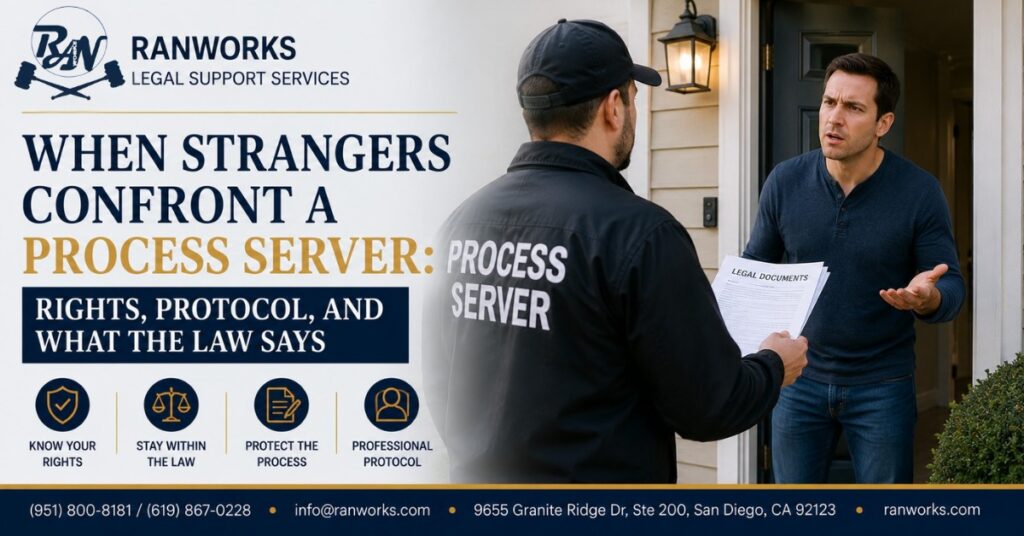
Process Servers in Gated Communities: California Law Most people who live in a gated community have no reason to think about how legal documents get delivered inside those gates. That changes the moment a lawsuit, subpoena, or restraining order names someone at that address. A recent Ranworks assignment in San Diego County shows how fast a routine attempt can shift. A server entered a gated community lawfully, found the subject not home, and while exiting was confronted by two residents with no connection to the case. They photographed her credentials, referenced being armed, and challenged her right to be there. She identified herself, disengaged, and waited outside for law enforcement. The service was not completed that day. The case record stayed clean. This is not an unusual story. Confrontations with neighbors, bystanders, and strangers happen on residential streets, at apartment complexes, and inside gated communities. For active California servers, these situations are not uncommon. This guide covers what the law says about these situations and what good protocol looks like when they arise. A Process Server’s Right to Be There California law is clear on this point. A registered process server is allowed to enter a staffed gated community to deliver legal documents. All they need to do is show valid identification and proof of their current registration. The gate guard or security personnel must provide reasonable access after the registered process server presents valid identification and proof of current registration. This is covered under California Code of Civil Procedure Section 415.21, and the full text is available on the California Legislative Information website. This right was expanded in 2020 to cover apartment buildings with three or more units and condo complexes with four or more units. The thinking behind the law is straightforward: living in a gated community does not put anyone beyond the reach of the courts. Two things have to be true for this law to apply. The server must be currently registered as a process server in California. And there must be an actual person staffing the gate at the time of the attempt. If the gate runs on an automated system with no guard present, this law does not apply, and the server has to find another way in or explore other options. When a Neighbor, Bystander, or Stranger Confronts the Server The person being served is often not the one who creates a difficult situation; it is the people around them. At a house, it might be a partner or roommate who comes to the door ready for a fight. At an apartment building, it could be a neighbor who sees what is happening and decides to get involved. At a gated community, it looks like what happened to the Ranworks server in San Diego: residents with no stake in the matter who photographed her credentials, referenced being armed, and challenged her right to be on the property. On a residential street, it might be a stranger who watched the server park, followed them to the door, and decided their presence needed explaining. Every one of these situations calls for the same response: State who you are and why you are there. If the confrontation continues, stop engaging and move away from the immediate area. Do not argue, do not try to push through, and do not stay on scene if the situation feels unsafe. Document everything before leaving the area. Contact law enforcement if threats are made. The San Diego server did exactly this. She said what needed to be said, recognized the situation was not going to resolve itself, and waited outside the gate for law enforcement rather than re-entering the property. What she did not do matters just as much. She did not raise her voice. She did not debate her right to be there beyond stating it once. She did not go back in. And before leaving, she documented everything. From a legal standpoint, none of these people, whether a neighbor, a bystander, or a stranger at the door, have any authority to stop a registered process server from completing a lawful delivery. Blocking, detaining, threatening, or physically interfering with a lawful process server may expose the individual to civil liability or, depending on the circumstances, criminal consequences. The emotional weight of what is being served, whether a divorce filing, a restraining order, or a civil judgment, sometimes spills onto the people nearby. That is a reality of the job. It is not a reason to engage. The goal in every confrontation is the same: leave the scene safely, and leave the case record clean. Why Documentation Decides the Outcome When a serve gets interrupted or contested, the notes from that day become the official record. GPS coordinates showing exactly where the server was, a timestamped log of what happened, and a written account of who was present and what was said: all of that becomes part of the file. Ranworks documents every attempt with GPS coordinates, timestamped notes, and a full written account of what the server observed. That level of detail matters directly for process serving services in California because a contested attempt with solid documentation is a very different situation from a contested attempt with a one-line note. If opposing counsel later questions whether service was handled properly, the documentation is what answers that question. GPS records are particularly useful because they verify the server’s location independently of anything the server wrote down. GPS-backed documentation can provide powerful corroborating evidence showing where and when a service attempt occurred. When the Attempt Cannot Be Completed Sometimes a gated community attempt does not work out on the first visit, or the second. When that happens, there are other options. In Bein v. Brechtel-Jochim Group, Inc. (1992), a California appellate court upheld substituted service through a gated community’s security personnel after access to the defendant was denied. The case remains an important authority when defendants use controlled-access communities to frustrate service attempts. That requires going back to court for
When Strangers Confront a Process Server: Rights, Protocol, and What the Law Says Read More »

Best Nationwide Process Serving Companies | Ranworks Attorneys who handle multi-state litigation face a vendor coordination problem that goes beyond simply finding someone to hand over documents. Each state has its own service rules, its own licensing standards, and its own requirements for what a valid proof of service must contain. Choosing the wrong partner for out-of-state work creates evidentiary risk that can resurface months later when service is challenged. Choosing the right national process serving company comes down to a specific set of verifiable criteria. General promises about reach or reliability are not enough. This article walks through what that criteria actually looks like in practice, what questions to ask before committing to a vendor, and what separates the providers that protect your case from the ones that create new problems. Why Your Choice of Process Serving Partner Affects Case Outcomes A defective proof of service is not just an administrative inconvenience. Under the California Code of Civil Procedure and the Federal Rules of Civil Procedure, service that fails to meet the required standards can be quashed. That means a case that was properly filed and diligently prosecuted can be set back months because the service event itself was improperly documented or executed. The risk compounds in multi-state matters because the plaintiff’s attorney has less direct visibility into what is happening on the ground. An attorney in San Diego coordinating service of a defendant in Ohio is relying entirely on whoever is handling that assignment. If that server lacks proper local credentials, submits an incomplete affidavit, or fails to follow Ohio’s specific service rules, the attorney may not find out until opposing counsel files a motion to quash. This is why the decision about which agency to trust with out-of-state assignments deserves more scrutiny than it often receives. What a Credentialed Nationwide Process Server Actually Looks Like Licensing requirements for process servers vary significantly by state. California requires registration with the county Sheriff’s office. Other states have their own registration or bonding requirements, and some have no formal licensing system at all. The absence of a state requirement does not mean credentials are unimportant. It means the buyer must look harder. A reputable coordinating agency uses locally licensed servers in states that have licensing requirements. For states without formal requirements, it uses servers who carry professional bonds and insurance. These are not cosmetic credentials. A bonded server provides a financial backstop if something goes wrong. Insurance protects the attorney’s client from losses caused by server error or misconduct. Before engaging any agency for out-of-state work, ask specifically whether the local servers they use in each state carry individual bonds and whether those bonds are current. Reputable agencies maintain this documentation on file and can produce it without delay. If a vendor is vague about the credentials of their network servers, that is meaningful information about the level of oversight they actually exercise. California Secretary of State Business Search — verify process server registration GPS Documentation: The Standard That Professional Nationwide Process Serving Should Meet The affidavit of service is the document that a court ultimately evaluates if service is challenged. A thorough affidavit includes the date and time of each attempt, the address where service was attempted or completed, a physical description of the person served, the method of service used, and the server’s declaration under penalty of perjury. GPS-tracked documentation adds objectively verifiable location data to that record. GPS tracking matters in cross-state service assignments because it removes the possibility of a server claiming service occurred at a location they never visited. When the affidavit carries coordinates and a timestamp tied to a specific address, opposing counsel faces a much higher evidentiary threshold to successfully argue that service did not take place. Ask any agency you are evaluating whether GPS documentation is standard on all assignments or only available on premium service tiers. An agency that reserves GPS tracking for higher-priced options is telling you something about how seriously they treat documentation on standard work. Federal Rules of Civil Procedure Rule 4 — requirements for summons and service Single Point of Contact: What It Means and Why It Matters One of the most practical advantages a national process serving company offers is administrative consolidation. Managing five defendants in five different states through five separate vendors means five different billing relationships, five different communication chains, and five different documentation formats arriving at different times. None of that work moves the case forward. It just creates overhead. A single coordinating agency absorbs all of that friction. One case number, one invoice, one contact who knows the full assignment history. When a service attempt fails in one state, the coordinating agency handles the follow-up strategy without requiring the attorney to re-explain the case to a new vendor. When affidavits arrive, they come in a consistent format that requires no translation between different server styles. This operational value is easy to underestimate when evaluating vendors on credential or price alone, but attorneys who have managed complex multi-state matters tend to place significant weight on it. Ranworks manages process serving coordination across all 50 states from a single point of contact in San Diego. Visit our Nationwide Process Serving Services page for full details. Turnaround Standards and Communication Expectations Process serving timelines are rarely the first thing attorneys ask about, but they matter considerably when litigation deadlines are involved. A provider that cannot give you a reliable first-attempt window is a provider that cannot help you plan. Standard service for most out-of-state assignments completes within 5 to 10 business days for the first attempt. Rush service typically shortens that to 72 hours. Same-day or emergency service is available from some coordinating agencies for the most time-sensitive matters. Know these tiers before you need them, because figuring it out on the day of an emergency deadline is not a practical option. Communication standards matter as much as speed. An agency that confirms receipt within one business hour, sends attempt notifications after each try,
Best Nationwide Process Serving Companies: What to Look for in a National Partner Read More »