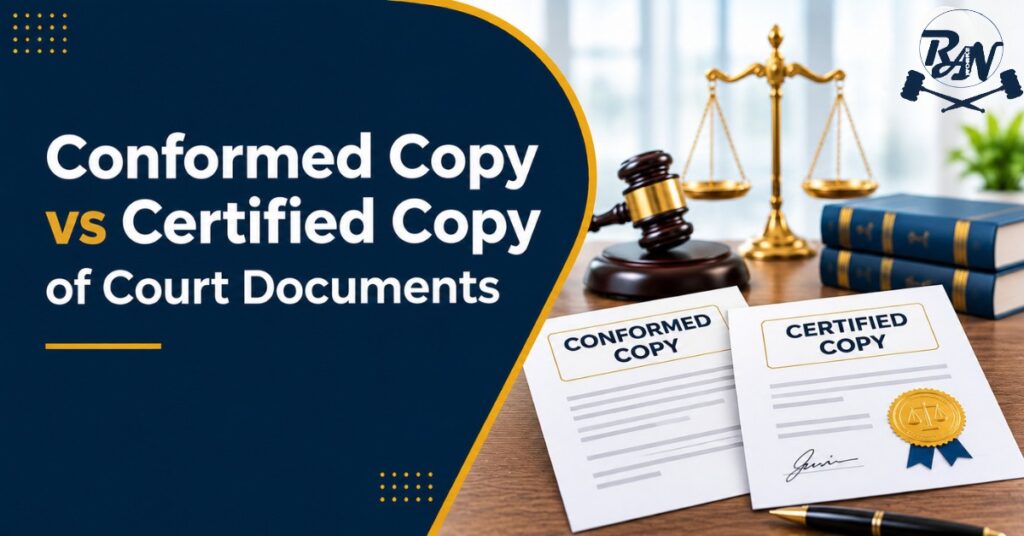
Conformed Copy vs Certified Copy of Court Documents
A conformed copy reflects the court document as filed and commonly includes the filing stamp or equivalent notations. A certified copy includes an official certification from the court’s authorized records custodian that it is a true copy of the record. A filing stamp alone is not the same as that certification. The distinction becomes practical when someone asks for a judgment, order, or pleading and rejects the PDF you already have. Before ordering another copy, find out exactly what the receiving court, agency, or institution requires. “Send the court papers” leaves too much room for misunderstanding. How The Main Types Of Copies Differ Copy type What it generally provides What it does not automatically provide Ordinary copy A reproduction of a document Confirmation of filing or official certification Conformed or file-stamped copy A copy reflecting the filed document and its filing information A clerk’s certification that the copy is a true court record Certified copy A copy accompanied by the authorized custodian’s official certification Every additional authentication another jurisdiction or recipient may require Courts use these terms and formats somewhat differently. When requesting a document, describe the required feature, such as the court’s certification, rather than relying only on a label. This guide explains the distinctions across U.S. court-document workflows; the issuing court’s procedures and the recipient’s requirements still control the particular request. What A Conformed Copy Is Used For A conformed copy helps a case file show the version that was filed. It may include the filing date, the court’s stamp, and notations corresponding to signatures or other features of the original. In electronic filing, the returned file-stamped document often fills that recordkeeping role. This matters when multiple drafts circulate before filing. A signed document in someone’s email is not necessarily the document accepted into the court record. Keeping the returned filed copy alongside the filing confirmation makes it easier to distinguish the submitted version from earlier drafts. A Payment Receipt Is Not A Conformed Copy A receipt may show that money was paid or a submission was transmitted. It does not, by itself, reproduce the accepted document. Likewise, a portal status message is not the complete filing packet. Keep each item for the fact it establishes rather than treating all automated emails as equivalent. If a filing service returns a file-stamped copy, check that it is the expected document, contains the correct case number, and includes the necessary pages and attachments. Resolve a missing exhibit while the assignment is still fresh. What Makes A Court Copy Certified Certification comes from the official responsible for the record, usually the clerk’s office or another authorized custodian. The certification attests to the copy’s correspondence with the official record. It does not certify that every allegation in a pleading is true or that every legal conclusion in the document is beyond challenge. You may need a certified copy when a receiving institution specifically requires one. The appropriate document could be a final judgment, a particular order, or a decree. The requesting institution should identify what it needs; an entire case file is not always necessary. Check The Document As Well As The Certification A perfectly certified copy of the wrong order is still the wrong deliverable. Confirm the document title, date, docket entry, and whether there is a later amended or corrected version. If the request refers to a final judgment, do not assume the complaint or a proposed order will satisfy it. Ask whether certification must cover attachments and whether multiple documents should be certified separately. Those details can affect both the clerk’s work and whether the recipient accepts the result. Is An Online Court Download A Certified Copy? Not automatically. A PDF downloaded from a court-records system may be a reliable copy of the filed document without carrying official certification. The fact that you paid a download fee does not turn it into a certified copy. For federal cases, the U.S. Courts guide to finding case records through PACER explains how to locate case information and records. When certification is required, check with the court that maintains the record for its certification procedure. State-court records have their own access systems and request processes. Some Courts Provide Electronic Certification An electronic format does not make a certified copy invalid simply because it lacks a raised paper seal. Some courts issue electronically certified records. Availability, verification features, and delivery methods depend on the issuing court. Before ordering, ask the receiving organization whether it accepts electronic certification. If it requires a paper certified copy, a printout of an electronically certified document may not meet its instructions. Keep any verification information with the document and avoid altering the certified file. A Notarized Copy Is A Different Request Notarization and court certification perform different functions. A notarial act involving a signature or copy does not automatically replace a certification issued by the custodian of the court record. Notary authority also varies by state, and some public records must be obtained directly from the issuing office. If someone asks for a “notarized court order,” clarify whether they actually mean a clerk-certified copy. If the document will be used in another country, ask about any separate authentication, exemplification, or apostille requirement before ordering. A standard certified copy should not be assumed to satisfy every cross-border use. How To Make A Precise Copy Request Start with the court that holds the record. Provide the case number, case name, document title, filing or entry date, and docket number if known. State whether you need an ordinary copy, a file-stamped copy, or official certification, and identify the number of copies required. Explain any delivery requirement, including whether electronic delivery is acceptable and when the document is needed. For older files, retrieval from archives may add time. For sealed or otherwise restricted records, access may require authorization. A records service cannot bypass those restrictions merely because a customer pays for retrieval. Confirm The Total Scope Before Approving The Request Copying, certification, searching, archival retrieval, delivery, and a provider’s handling charge
Conformed Copy vs Certified Copy of Court Documents Read More »