If you’re trying to figure out the real court filing cost in California, here’s the honest answer: the base court fee runs $225 to $435, depending on your case type and amount at issue. In Riverside, San Bernardino, and San Francisco, local surcharges can push that higher, up to $450 in some cases. Then you add e-filing charges. Then rush fees if your deadline is tight.
Nobody quotes you the full number upfront. That’s not because it’s complicated. It’s because most people quoting you don’t break it down. So let’s break it down.
What You’re Actually Paying For (It’s Not One Number)
People treat “filing fee” like it’s a single line item. It’s not. Depending on how you file, you’re looking at some combination of:
- The court fee itself — set by the state, based on case type and case value
- E-filing or transaction fees — charged by the court’s e-filing system and your electronic filing service provider (EFSP), if you file electronically
- Filing service cost — what you pay a company to prepare, submit, or hand-deliver documents on your behalf, if you’re not doing it yourself
If you self-file electronically, you’re paying court fees plus e-filing charges. If you hire someone to handle it for you, you’re paying court fee plus their service fee plus whatever e-filing or delivery costs come with it. Those are different bills, and mixing them up is exactly how people get surprised.
Here’s the rookie mistake: quoting someone “the court fee” and letting them assume that’s the whole cost. Then the extra charges show up and the client feels blindsided. Don’t do that. Give people the full stack up front.
California Court Filing Fees: The Real Numbers
Under the current statewide civil fee schedule (effective January 1, 2026), here’s what California Superior Courts charge for the first paper filed in a civil case:
- Limited civil cases up to $10,000: $225
- Limited civil cases over $10,000, up to $35,000: $370
- Unlimited civil cases over $35,000: $435
Answers and other first papers filed by a responding party carry the same fee, based on the same tiers.
Unlawful detainer cases run a slightly different track: $240 for claims up to $10,000, $385 for $10,000 to $35,000. Worth knowing if that’s your case type, since it’s easy to assume all civil fees follow one schedule.
A few counties tack on local courthouse construction surcharges. Riverside, San Bernardino, and San Francisco are the usual suspects, and depending on the case type, that can add $10 to $50 on top of the base fee. If you’re filing in one of those counties, don’t quote the base number and call it done, check the local total first.
Court fees change. For the current statewide schedule, see the California Judicial Branch’s civil fee information.
E-Filing Fees in California: What Nobody Tells You
E-filing gets sold as “cheap” or “free.” It’s neither. The typical stack for e-filing fees in California Superior Courts looks like this:
- Court e-filing system fee: commonly $3.50 to $5 per envelope, though the exact number depends on the court
- EFSP provider fee: charged by whichever electronic filing service provider you use, varies by vendor
- Payment processing fee: roughly 3% on credit card payments, or up to $1 flat on ACH
These charges are separate from the court’s base filing fee, and the total depends on the court, the system, the provider, and how you pay. None of that makes e-filing a bad deal, it just means “e-filing is cheap” is only half the sentence.
For routine filings, e-filing is usually less expensive than hiring a runner, especially if you’re comfortable submitting the documents yourself. But if you need professional filing assistance on top of that, the total cost includes their fee too.
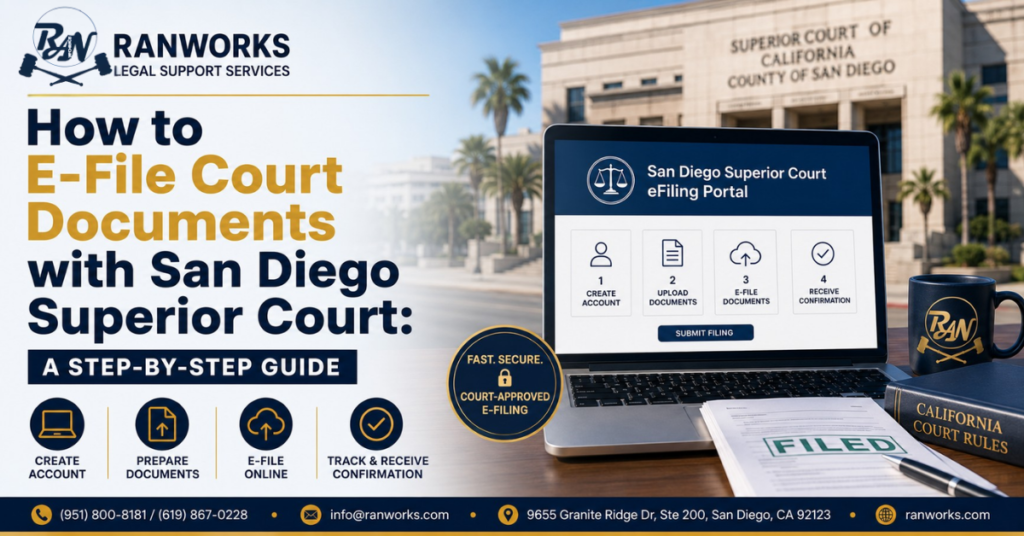
For the full walkthrough of how the submission process actually works, we put together a step-by-step e-filing guide covering formatting, portals, and common rejection reasons.
Same-Day Filing: What It Costs and When It’s Worth Paying For
Same-day court filing cost isn’t a state-imposed fee. California courts don’t charge extra for speed, the court fee is the court fee whether it’s filed today or next week. What you’re actually paying for with same-day service is a filing company or courthouse runner who drops everything to make your deadline.
Ranworks’ physical court delivery starts at $75, with pricing varying by county and courthouse. Other filing services price rush work as a flat add-on or an hourly rate. Ask exactly what a quote covers, filing fee, service fee, and delivery, before you agree to anything.
When same-day filing is worth the money:
- A filing deadline or statute-of-limitations date is closing in
- You’ve got an ex parte hearing tomorrow morning
- A TRO needs to be on file before a specific cutoff
- Opposing counsel is playing games with timing and you can’t afford to lose the race
When it’s a waste of money:
- Routine filings with no real deadline pressure
- Anything you could’ve e-filed three days ago if someone had planned ahead
One important note: if you’re up against a statute of limitations or a court-ordered deadline, confirm the exact deadline and requirements with an attorney or the court itself. A filing service can get your documents to the clerk fast, but it can’t give you legal advice on whether you’re cutting it close.
E-Filing vs. Same-Day Delivery: Which One Do You Actually Need
This isn’t really a “which is better” question. It’s a “which one fits your situation” question.
Use e-filing when:
- The court accepts electronic submission for your case type
- You’ve got at least a day or two of runway before your deadline
- You want a paper trail and instant transaction confirmation
Use same-day physical delivery when:
- The court doesn’t accept e-filing for that document type
- Your e-filing window already closed for the day
- You need original signatures or exhibits that can’t go electronic
- The clerk needs to review something in person before accepting it
One more thing: not every California court accepts e-filing for every case type. Some counties are further along than others. If you assume e-filing is always an option and find out otherwise on deadline day, you’ve got a problem. Confirm ahead of time, not under pressure.
Common Mistakes That Cost Money
- Filing in the wrong civil tier.
Filing something as limited civil when it should be unlimited (or vice versa) means the court kicks it back and you pay the correction fee too. - Ignoring the fee stack.
Budgeting only for the court fee and getting surprised by EFSP and processing charges. - Waiting until the deadline to check e-filing eligibility.
Find out today whether your court accepts e-filing for your document type, not tomorrow at 4:45 PM. - Using a vendor with no local knowledge.
A filing service that doesn’t know a specific county’s surcharges or clerk quirks will cost you time, and time on a deadline is money. - Assuming same-day pricing is a court charge.
It’s not. That cost comes from whoever you hire to handle the rush, not from the state.
If you’re regularly working with California courts, it’s worth understanding the full range of court filing services Ranworks offers before a deadline forces your hand.
FAQs: California Court Filing Costs
1. How much does it cost to file a lawsuit in California?
2. Is e-filing cheaper than filing in person in California?
3. How fast is same-day court filing in California?
4. Do all California courts accept e-filing?
5. Can I get my court filing fee waived?
6. What’s the difference between a court filing fee and a filing service fee?
Get a Straight Answer on Your Filing Costs
Every county has its own quirks, its own surcharges, and its own e-filing rules. If you want a real number instead of a guess, talk to our team, and we’ll tell you exactly what your filing will cost before you commit to anything.