
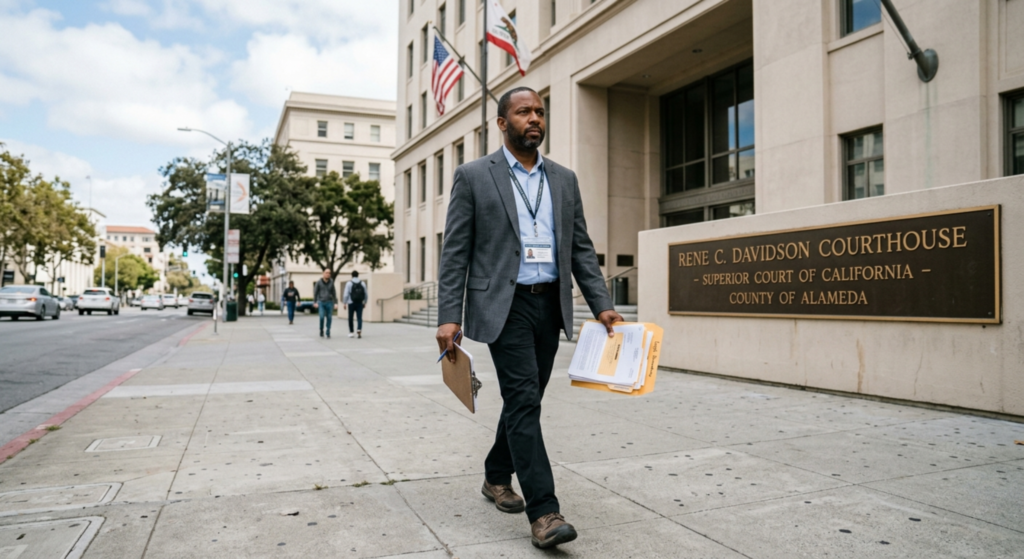
Alameda County is one of the most active civil litigation markets in California. With over 1.6 million residents spread across Oakland, Fremont, Berkeley, Hayward, Livermore, and nearly a dozen other cities, the county has built one of the most diverse legal economies in the state. That density of people, businesses, and institutions means a steady, year-round volume of civil suits, family law filings, business disputes, unlawful detainer cases, and collection matters moving through the Alameda County Superior Court at any given time.
For law firms that regularly file here, the East Bay is not a single market. It is several overlapping ones, each with its own demographics, its own service challenges, and its own practical rhythms. Oakland moves differently from Livermore. Berkeley addresses go stale faster than Fremont ones. What works on a residential service in Hayward does not always translate to a commercial defendant in Emeryville.
Getting documents served correctly and on time across the board is not a back-office detail. It is often the difference between a case moving forward and a default being rejected. This guide covers what California law requires for valid service of process, what Alameda County’s own local rules add on top of that, and what attorneys should look for when choosing a process server for East Bay assignments.
What California Law Requires for Service of Process
The Code of Civil Procedure governs service of process in California, primarily sections 415.10 through 415.50. These statutes define who can serve documents, which methods are permissible, and what constitutes valid proof of service.
Personal service under CCP § 415.10 is the foundational method. It requires direct, in-person delivery of the summons and complaint to the named party. A server must be at least 18 years old and cannot be a party to the case. Personal service is complete at the moment of delivery.
Substitute service under CCP § 415.20(b) becomes available only when personal service cannot be accomplished “with reasonable diligence.” Under this method, documents may be left with a competent adult at the subject’s home or place of business, followed by a first-class mailing to that same address. Under California law, substitute service is deemed complete 10 days after the mailing date.
The phrase “reasonable diligence” sounds straightforward, but courts scrutinize it closely. Standard practice and case law generally require two to three attempts at different times and on different days before substitute service is justified. Going straight to substitute service after a single attempt or failing to document what happened at each visit creates a serious risk that a court will reject a proof of service or quash service entirely.
You can read the full text of CCP § 415.20 directly through the California Legislative Information portal.
Alameda County’s Local Rule 3.50: A Stricter Standard Than State Law
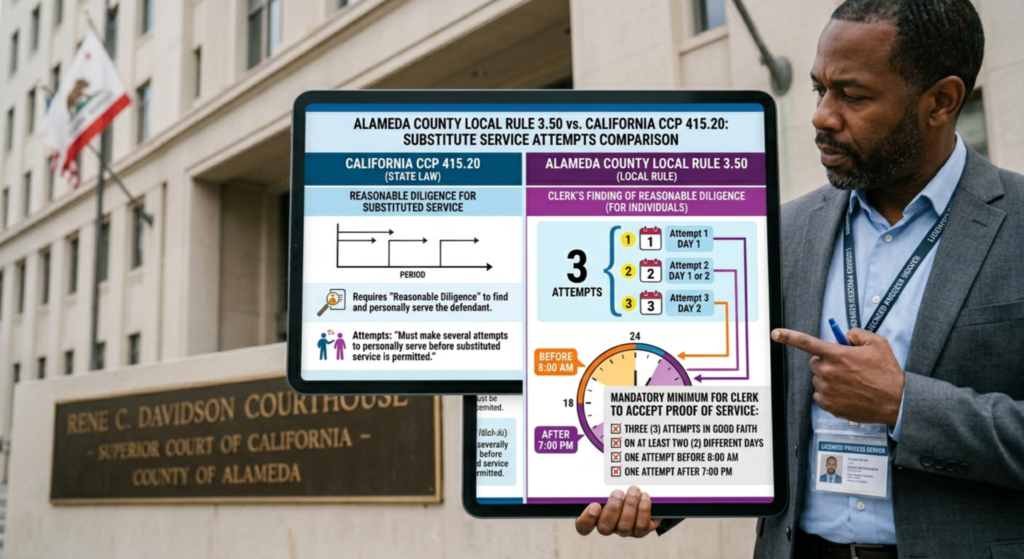
This is the detail that catches attorneys off guard most often. While California’s statewide standard for substitute service requires evidence of “reasonable diligence,” Alameda County has a local rule that sets explicit minimum requirements going further than what the state statute specifies.
Under Alameda County Local Rule 3.50, substitute service under CCP § 415.20 requires all of the following:
- At least three attempts at service
- Spread across at least two different days
- One attempt must occur before 8:00 AM
- One attempt must occur after 7:00 PM
- A third attempt at any other time
These requirements are mandatory. A proof of service that would be perfectly valid in most other California counties may be rejected in Alameda County if it does not meet this specific standard. Courts there have rejected requests to enter default specifically because the proof of service on file only reflected two attempts rather than three, or because all attempts were made during standard business hours.
For any firm regularly filing in Oakland, Berkeley, or Hayward, this is a compliance point that belongs in your vendor checklist. When you work with Ranworks on Alameda County assignments, every substituted service follows Local Rule 3.50 by default, with documented attempts before 8:00 AM, after 7:00 PM, and at a third distinct time, across at least two calendar days. The affidavit reflects all of it. You do not need to ask.
Courthouse Locations Across Alameda County
The Alameda County Superior Court operates multiple courthouse locations, each handling specific case types and serving different geographic communities within the county.
The Rene C. Davidson Courthouse at 1225 Fallon Street in Oakland is the primary location for unlimited civil litigation, criminal trials, and major jury matters. Most of the commercial litigation, personal injury, and business dispute cases in Alameda County are filed and heard here.
Hayward Hall of Justice at 24405 Amador Street in Hayward handles family law cases, juvenile matters, and some probate filings, serving the mid-county and southern communities, including San Leandro, Castro Valley, and Union City.
Fremont Hall of Justice at 39439 Paseo Padre Parkway handles traffic, small claims, and limited civil cases for Fremont, Newark, and the southern Alameda corridor.
East County Hall of Justice at 5151 Gleason Drive in Dublin serves the Tri-Valley community,s including Livermore, Pleasanton, and Dublin, handling civil limited cases, small claims, and related matters.
Knowing which courthouse governs a specific case type matters when coordinating service and court filing together. A proof of service that needs same-day e-filing with the Civil Division in Oakland requires a different logistics chain than a small claims matter based in Fremont. Ranworks handles both.
Service Challenges by City and Area
Alameda County spans over 820 square miles, and the practical challenges of process serving vary considerably from one city to the next.
Oakland accounts for a large share of the county’s civil litigation volume. It is a dense urban environment with a mix of multi-unit residential buildings with secured access, high-rise commercial addresses, and a large number of small business defendants. Timing matters significantly here. Subjects who are not home during standard weekday hours may be reachable in early mornings or on weekend mornings. For secured apartment buildings, servers need to have strategies for gaining lawful access rather than simply standing outside.
Berkeley and Emeryville carry a mix of residential assignments and commercial defendants in the tech and food industries. Berkeley’s university-adjacent areas mean a higher proportion of rental housing, temporary residents, and addresses that change frequently. Skip tracing is often needed before an address from months earlier is still current.
Fremont and Newark in the southern corridor tend toward residential assignments in suburban neighborhoods. Unlawful detainer matters and family law papers are common here. Subjects tend to follow more predictable residential schedules, making early evening attempts productive.
Hayward and San Leandro generate consistent collections, landlord-tenant, and employment litigation. A high concentration of small businesses means commercial service assignments alongside residential ones.
Livermore and Pleasanton in the Tri-Valley are growing legal markets. Business litigation, professional disputes, and family law matters involving defendants with steady professional employment are common. These subjects are often reachable at workplaces during business hours when residential service proves difficult.
What a GPS-Documented Proof of Service Actually Covers
Among the most common points of challenge in contested cases is whether service actually occurred at the stated time and location. A bare paper affidavit that says “I served documents at 123 Main Street at 2:15 PM” carries no electronic verification of where the server physically was at that moment.
GPS-tracked process serving addresses this directly. When a Ranworks server makes a service attempt in Alameda County, the documentation includes GPS coordinates at the time and location of the attempt, a timestamp, a physical description of the person served or encountered, and a declaration signed under penalty of perjury. The affidavit includes specific field notes, not general summaries.
This matters in practice for contested divorce proceedings, civil harassment restraining orders, business litigation where the defendant denies receiving documents, and any case where the other side has an incentive to challenge service. A GPS-verified, time-stamped affidavit from a licensed Ranworks process server provides a factual record that is substantially harder to dispute in court than a paper-only declaration.
Our California process serving page covers the full scope of what is included with every service attempt, including proof of service documentation standards across different California courts.
When an Address Does Not Work Out
A significant share of Alameda County assignments involve addresses that turn out to be outdated. Subjects in Oakland, Berkeley, and Fremont move without updating legal records. They give attorneys addresses from years ago. They actively avoid service by changing locations.
When standard attempts fail, the next step is skip tracing. Ranworks skip traces using national databases, including LexisNexis and TLO, which pull current address data, employment records, phone numbers, vehicle registrations, and property ownership information. Most searches are completed within 24 to 48 hours for subjects with some identifying information.
For subjects who are present at a known address but actively avoiding contact, stakeout service is available. A server monitors the location at varied times — including before 8:00 AM and after 7:00 PM, which also satisfies Alameda County’s Local Rule 3.50 timing requirements — until the subject appears.
Our skip tracing service integrates directly with process serving assignments. Once a current address is confirmed, we proceed to service without requiring you to coordinate with a separate vendor.
Court Filing in Alameda County
Many law firms with Alameda County cases also need support with court filing. The Alameda County Superior Court accepts electronic filing for most civil matters through its civil e-filing public portal. Filing deadlines in civil cases are hard stops, and rejected e-filings that come back with technical errors after business hours can derail an otherwise well-prepared motion.
Ranworks handles e-filing for all California courts, including the Alameda County Superior Court, at $22.95 plus applicable court fees. Physical courthouse delivery to the Rene C. Davidson Courthouse in Oakland, Hayward Hall of Justice, Fremont Hall of Justice, and Dublin’s East County Hall of Justice is also available for filings that need in-person submission.
The most common use case is combining service and court filing in sequence. We serve documents, obtain a signed proof of service, and e-file it with the court the same day. Our court filing services page covers the full filing workflow, including same-day cutoff times.
Statistics Worth Knowing
Alameda County is the seventh most populous county in California. Since 2012, more than 2.1 million total cases of all types have been filed in the county’s courts, according to aggregated state court records data. Civil filings, including unlimited civil cases, limited civil matters, and small claims, represent a substantial and steady share of annual case volume at the county level.
Statewide, the Judicial Council of California’s 2025 Court Statistics Report documents that California’s superior courts handle millions of case filings annually across all 58 counties, with civil filings maintaining consistent year-over-year volume across the state’s most populous jurisdictions. Alameda County, as one of those high-volume jurisdictions, reflects this pattern in its own court activity.
For law firms with regular Alameda County caseloads, this volume translates to a consistent need for reliable process serving across a geographically and demographically varied county. Having a process server who understands the local courthouse structure, knows Local Rule 3.50, and can document service attempts to GPS-verified standards removes a category of risk from every case.
Getting Started
For law firms with cases in Oakland, Fremont, Berkeley, Hayward, Livermore, or any other Alameda County city, Ranworks provides licensed, GPS-documented process serving with Alameda County Local Rule 3.50 compliance built into every substituted service assignment.
Submit documents by email to documents@ranworks.com, call 888-636-0293, or submit a request through ranworks.com. We confirm receipt and issue a case number within an hour during business hours. Ranworks has served California’s legal community since 2002, and the same documentation standards that built our Southern California work apply to every East Bay assignment.
Frequently Asked Questions
1. Who can legally serve process in Alameda County?
Any person 18 years of age or older who is not a party to the case may serve process in California. Most attorneys use registered process servers who are bonded and enrolled with the California Secretary of State, because a registered server’s signed return of service creates a presumption of valid service that can be challenged only by strong and convincing evidence. You can verify a server’s registration status through the California Secretary of State’s registrant lookup.
2. What does Alameda County Local Rule 3.50 require for substitute service?
Alameda County requires a minimum of three service attempts across at least two different days before substitute service is valid under CCP § 415.20. One attempt must occur before 8:00 AM, one must occur after 7:00 PM, and a third must be made at a separate time. This is stricter than the general California standard. Failing to meet this requirement can result in a rejected proof of service and a denied default.
3. How long does process serving in Alameda County typically take?
Standard service in Oakland, Fremont, Berkeley, and Hayward generally sees a first attempt within three to five business days of assignment. Most assignments are completed within one week. Rush service is available for a first attempt within 72 hours, and expedited service covers a 24-hour turnaround when a deadline is immediate. For assignments involving skip tracing, add one to two business days for the address search before service begins.
4. What types of documents can Ranworks serve in Alameda County?
Ranworks serves summons and complaints, subpoenas, restraining orders, civil harassment orders, divorce and family law papers, unlawful detainer notices, small claims documents, wage garnishment papers, probate documents, and any other legal document requiring formal service under California law. We serve both individuals and business entities, including registered agents and authorized corporate representatives.
5. Can Ranworks handle service across multiple Bay Area counties at once?
Yes. Cases that require service in Alameda County alongside Contra Costa, Santa Clara, San Francisco, or other Bay Area counties are coordinated from a single point of contact. You work with one Ranworks contact, receive one invoice, and get proofs of service from all counties through the same case management process. For assignments beyond California, our nationwide process serving network covers all 50 states.
